

_edited.png)


13-15yrs Developing in my Club
Phase 3
Welcome to our Gaelic games program, where fun meets fundamental skills! We focus on introducing basic movement skills through playful activities, ensuring that every participant enjoys their time while learning. Our goal is to build confidence and creativity by teaching essential techniques like catching, kicking, striking, and passing in small-sided games. Join us in building a supportive club environment where everyone can thrive and discover the world of Gaelic games!
Small Sided Games
Match awareness beats isolated drills every time.
-
3v3 to sharpen quick decisions
-
6v6 to build team structure and movement
-
Change pitch size and touch limits to challenge players
-
More ball touches = stronger skills under pressure
-
Everyone stays involved and engaged the whole time
-
Small-sided games recreate match intensity while improving technical skills at the same time.


13-15 year old Players
Will:
·Become more physically developed
·Players will develop at different rates and this should be kept in mind during physical training
·Possess a good understanding of the rules and objectives of the game
·Begin to develop tactical awareness
·Begin to balance sport as part of lifestyle and routines

Goals of Phase 3
·Advanced technical skills
·To use skills under pressure and at speed
·To adhere to tactics/ game strategy
·To play full sided competitive games
·The importance of concentration and better decision making
It offers a comprehensive library of age-appropriate activities tailored to different stages of the GAA Player Development Pathway.


Acceleration/ Deceleration
Core Exercises
Body weight strength exercises: push up, squats
Conditioning exercises
(Under qualified supervised)
SKILLS DEVELOPMENT
THE GAA ACTIVITY PLANNER
-
It offers age-appropriate activities for every stage of the GAA Player Pathway.
-
Activities designed for all ages and development stages in the GAA Player Pathway.
-
A complete set of drills for each phase of the GAA Player Pathway.
Using the GAA Activity Planner
🔍 Key Features
-
Age & Stage Filters: Organize activities by age group (e.g., 4–6 years, 7–9 years, 10–11 years) and development stage (e.g., F1, F2, F3, T1, T2, T3, T4, E1.
-
Skill Categories: Select drills based on specific skills such as sending, receiving, travelling, striking, and maintaining possession.
-
Activity Types: Choose from various formats like full games, small-sided games, conditioned games, fitness exercises, and inclusive activities.
-
Social Distancing Options: Filter for activities that are friendly to social distancing, ensuring safe participation.
🧠 How It Supports Development
The planner aligns with the GAA's Player Pathway, which emphasizes age-appropriate learning and skill progression. By using the planner, coaches can:
-
Design sessions that match the developmental needs of players.
-
Incorporate a variety of drills to keep training engaging and effective.
-
Ensure that activities are inclusive and accessible to all participants.
📚 Additional Resources
Beyond the Activity Planner,learning.gaa.ie offers a wealth of resources, including:
-
Skill Challenges: Activities aimed at improving specific skills, such as the Go Games Skill Challenges for children aged 7–12. learning.gaa.ie
-
PE Resources: The Céim ar Aghaidh (Step Ahead) program provides lesson plans and activities for primary school teachers to integrate Gaelic games into physical education.
-
Coach Education: Courses like the Introduction to Coaching Gaelic Games (ICGG) Award offer foundational knowledge for new coaches.
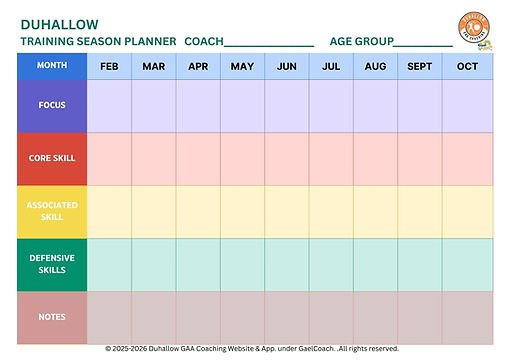
Coach Season Planner
Sample

Coach Season Planner
Printable Template

TAP TO
OPEN
Coach Session Planner
Sample

Coach Session Planner
Printable Template
TAP TO
OPEN
GAA Football Rules for Ages 13-15 years
For players aged 13–15, the rules of Gaelic Athletic Association (GAA) football are designed to help young players develop their skills, teamwork, and understanding of the game while playing in a safe and enjoyable environment. At this level, players begin to follow many of the standard rules used in adult football, including passing, tackling, scoring, and positioning on the field. The game encourages speed, skill, and decision-making, while also promoting respect for teammates, opponents, and referees. Learning the rules helps players play fairly, improve their abilities, and enjoy the fast-paced and exciting sport of Gaelic football. 🏐🏃♂️

GAA Football Rules for Ages 13-15 years
3. Equipment & Safety
-
Players must wear standard football boots, jersey, shorts and socks.
-
Mouthguards are compulsory in all Gaelic football games for player safety.
-
Referees monitor the game to ensure safe tackling and fair play.
4. Contact & Physical Play
-
Shoulder-to-shoulder contact is allowed when competing for the ball.
-
Tackling must be fair and controlled, focusing on dispossessing the ball rather than the player.
-
Dangerous or reckless challenges are penalised to protect player safety.
5. Playing the Ball
Players are expected to perform the core football skills confidently:
-
Soloing (bouncing or toe-tapping the ball while running)
-
Hand passing using the fist
-
Kicking from the hands or ground
-
Catching high balls
-
Passing and shooting accurately
Players may take four steps with the ball before soloing or passing.
1. Game Format
-
Games begin to follow the full Gaelic football rules more closely as players prepare for adult football.
-
Teams usually play 15 vs 15 on a full-sized pitch, depending on club numbers and competition structure.
-
Games are played as part of organised leagues and championships, helping players experience structured competition.
2. Playing Time
-
Matches are generally played in two halves, usually between 20–25 minutes per half depending on the competition.
-
Substitutions are allowed, but coaches are encouraged to ensure all players receive meaningful game time.
🔴
🔴
🟢
6. Scoring
-
A goal (ball into the net) = 3 points
-
A point (ball over the crossbar) = 1 point
Scores are officially recorded and contribute to league tables and competitions.
7. Restarts
-
Games begin with a throw-in by the referee at midfield.
-
Kick-outs restart play after a score or wide ball.
-
Free kicks are awarded when a foul occurs.
8. Positions & Team Play
-
Players typically play in structured positions, including defenders, midfielders, and forwards.
-
Teams are encouraged to develop tactics, teamwork and communication.
9. Discipline & Fair Play
-
Referees enforce the rules using free kicks, yellow cards, and red cards when necessary.
-
Players are encouraged to demonstrate respect, sportsmanship, and discipline at all times.
10. Development Focus
-
At this age, players continue to improve:
-
Skill level
-
Fitness and endurance
-
Game awareness and decision-making
-
Team tactics
-
-
Coaches aim to prepare players for minor and adult football while maintaining enjoyment of the game.
🔴
🟢
🔴
🔴
🔴
🟢
🟢


🏐 Summary
For ages 13–15, Gaelic football becomes more structured and competitive:
-
Full teams and full pitches
-
Official scoring and competitions
-
Advanced skill development
-
Greater tactical awareness
-
Continued emphasis on safety and sportsmanship


GAA Hurling Rules for Ages 13-15 years

For players aged 13–15, the rules of hurling begin to closely follow the full game played at adult level in the Gaelic Athletic Association. At this stage, players develop more advanced skills such as striking from the hand, catching high balls, soloing the sliotar on the hurley, and working together as a team in set positions on the field. Games are played on larger pitches with full teams, helping players build fitness, confidence, and tactical awareness. While competition becomes more structured, the focus remains on skill development, fair play, and enjoyment as players continue learning and preparing for higher levels of hurling.
GAA Hurling Rules for Ages 13-15 years
1. Game Format
-
Games begin to follow the full rules of hurling, preparing players for minor and adult levels.
-
Teams usually play 15 vs 15 on a full-sized pitch, depending on the competition or club structure.
-
Matches are played within organised leagues and championships, introducing players to more structured competition.
2. Playing Time
-
Games are generally played in two halves, typically 20–25 minutes per half depending on the competition.
-
Substitutions are allowed, but coaches are encouraged to ensure all players receive meaningful playing time.
3. Equipment & Safety
-
Helmets with faceguards are mandatory for all players.
-
Players must use a properly sized hurley suited to their height and ability.
-
A standard sliotar is used at this age level.
-
Referees and coaches ensure the game is played safely and fairly.
4. Contact & Physical Play
-
Shoulder-to-shoulder contact is permitted when contesting the ball.
-
Players may use their hurley to hook or block an opponent’s strike when done safely.
-
Dangerous play such as high swinging, pulling across the body, or reckless tackles is penalised.
5. Playing the Ball
Players are expected to demonstrate a wide range of hurling skills:
-
Ground striking
-
Lifting the sliotar with the hurley
-
Striking from the hand
-
Catching high balls
-
Soloing the sliotar on the hurley
-
Accurate passing and shooting
Players can carry the sliotar for four steps before striking, passing, or soloing.
6. Scoring
-
A goal (ball into the net) = 3 points
-
A point (ball over the crossbar) = 1 point
Scores are officially recorded and contribute to league standings and competitions.
🔴
🔴
🟢
7. Restarts
-
Games begin with a throw-in by the referee at midfield.
-
Puck-outs restart play after a score or wide ball.
-
Free pucks are awarded for fouls or rule infringements.
8. Positions & Team Play
-
Teams play with structured positions, including defenders, midfielders, and forwards.
-
Players begin to learn team tactics, positioning, and game strategies.
9. Discipline & Fair Play
-
Referees enforce rules using free pucks, yellow cards, and red cards where necessary.
-
Players are expected to show respect, discipline, and good sportsmanship.
10. Development Focus
At this stage, players continue developing:
-
Advanced striking and ball control
-
Speed and fitness
-
Decision-making and tactical awareness
-
Teamwork and communication
Coaches focus on preparing players for minor and adult hurling while keeping the game enjoyable and competitive.
🔴
🟢
🟢
🟢
🔴
🟢
🟢


Summary
For ages 13–15, hurling becomes closer to the full adult game:
-
Full teams and full pitches
-
Official scoring and organised competitions
-
Advanced skill and tactical development
-
Continued focus on safety and fair play
