
_edited.png)

Skill Development Activities
"Welcome to Skill Development Activities page! Here, you'll find a variety engaging examples from the GAA Activity Planner designed to enhance your skills. Whether you're a beginner or looking to refine your techniques, these activities are perfect for individuals of all ages. Explore the options and take the next step in your development journey!"
All linked GAA activity videos are from LearningGAA.ie unless otherwise stated.
Coach Season Planner
Sample


Coach Season Planner
Printable Template


TAP TO
OPEN
Coach Session Planner
Sample


Coach Session Planner
Printable Template

TAP TO
OPEN
© 2026 The Duhallow Juvenile Clubs GAA Coaching Website & App. All rights reserved.
© 2026 The Duhallow Juvenile Clubs GAA Coaching Website & App. All rights reserved.
© 2026 The Duhallow Juvenile Clubs GAA Coaching Website & App. All rights reserved.
© 2026 The Duhallow Juvenile Clubs GAA Coaching Website & App. All rights reserved.
Football & Hurling
Skills Assessment
4-7 years
-
GAA skills Assessment for 4–7 year olds focuses on fun, participation, and basic movement skills.
-
Activities are simple, enjoyable, and suited to young children’s abilities.
-
Key skills include running, jumping, throwing, catching, kicking, and striking.
-
Emphasis is placed on effort and enjoyment rather than competition or scores.
-
Assessment helps children develop confidence and a love for Gaelic games.
-
It supports early physical development and coordination.
-
All children are encouraged and included, helping them learn through play.


TAP TO
OPEN
TAP TO
OPEN

-
Coaching Tip: With 4–7 year olds, keep it fun and relaxed. There’s no need to label activities as “skill testing.” Instead, use enjoyable games and drills as opportunities to make your own observations and gently track development.
-
Focus on effort and engagement over outcomes. At this age, confidence, coordination, and enjoyment are just as important as technical skill. Observe how children move, try new skills, and interact with others — these small moments often tell you more than any formal assessment.
4-7 years Football

Describe GAA football to 4-7yr olds
GAA football is a fun game where you run, kick, catch, and hand-pass a ball while trying to score into goals. It’s all about moving, having fun, and playing with your friends.
Equipment for 4–7-year-olds:
-
A soft football (smaller and lighter for young kids)
-
Cones to mark out spaces
-
Bibs to tell teams apart
-
Small goals or even just two cones as a goal
Simple, safe, and fun!


4-7 years Football
BOUNCE
🏐 Key Points
-
Start with 2 hands, progress to 1 hand.
-
Push down on the ball while bouncing.
-
Catch with 2 hands at hip height.


Videos of Additional Bounce Activities
Credit: Dungloe GAA
Credit: GAA Learning
Credit:Connacht GAA
Credit : LearningGAA.ie
🏐 Bounce Checklist
✅ Technique & Rules
-
After 4 steps, choose one of the following:
-
Bounce the ball
-
Perform a toe tap
-
Play the ball away
-
-
Only one bounce is permitted in succession.
-
Hold the ball with both hands.
-
Keep eyes on the ball.
-
Spread fingers behind the ball.
-
Extend the arm and push the ball to the ground.
✅ Skill Indicators
-
Able to apply consistent force for continuous bounces.
-
Can bounce with either hand.
-
Able to look up occasionally while bouncing.
✅ If the Child Tends to Slap at the Ball
-
Have the child sit and practice “drop, catch” a few times.
-
Start slowly, then build up speed progressively as control improves.

4-7 years Football
HAND PASSING
🏐 Key Points
-
Passing the ball using your hand to strike it to a teammate.
-
Hold ball in non-dominant hand.
-
Strike with a closed fist or flat hand from opposite hand.
-
Step into the pass and follow through.
-
Keep it accurate, chest-height, and quick.
-
Partner passing, moving hand-pass drills, pressure passing.

________


Videos of Additional
Hand Passing Activities
Credit: LearningGAA.ie
Credit: Tramore GAA
Credit: LearningGAA.ie
Credit:Connacht GAA
Credit: LearningGAA.ie
🏐 Handpass Checklist
✅ Technique & Rules
-
Hold the ball securely in one hand.
-
Make a clear striking action with the other hand.
-
Strike the ball with the flat of the hand.
-
Follow through towards the target.
-
Step forward to add power and accuracy.
-
Handpass must be a clear strike (not a throw).
✅ Skill Indicators
-
Can handpass accurately over short and medium distances.
-
Uses both left and right hand when encouraged.
-
Can handpass while moving.
-
Selects the correct handpass option in games.
-
Maintains balance after the pass.
✅ If the Player Struggles with Handpass
-
Practice stationary handpass first.
-
Focus on strike action (no pushing).
-
Use targets to improve accuracy.
-
Reduce distance, then build gradually.
4-7 years Football
CATCH & PASS
-
Eye on the ball
-
Hands out in front
-
Hands like a bread basket to catch
🏐 Key Points


Videos of Additional
Catch & Pass Activities
Credit : Tramore GAA
Credit : St Pat's GAA
Credit : Connacht GAA
Credit :Learning GAA
🏐 Catch & Pass Checklist
✅ Technique & Rules
-
Eyes on the ball.
-
Hands out in front, fingers spread.
-
Move towards the ball.
-
Cushion the catch into hands/chest.
-
For handpass: hold with one hand, strike with the flat of the other, follow through.
✅ Skill Indicators
-
Catches the ball consistently.
-
Can handpass with either hand.
-
Makes short, accurate passes.
-
Looks up before passing.
✅ If the Child Struggles to Catch
-
Practice simple “drop, catch”.
-
Start with slow, short passes.
-
Use softer/lighter balls for confidence.
4-7 years Football
KICK
🏐 Key Points
-
Start kicking off the ground, both feet
-
Bounce & kick
-
Drop ball & kick
-
Kicking from hand whilst standing still.


Videos of Additional
Kick Activities
Credit :Ulster GAA
Credit :Live Learn Love Gaelic Games
Credit :Ulster GAA
Credit :Learning GAA
🏐 Kick Checklist
✅ Technique & Rules
-
Keep eyes on the ball.
-
Step beside the ball with non-kicking foot.
-
Strike the ball with the instep (laces), not toe.
-
Follow through towards the target.
-
Keep body balanced over the ball.
✅ Skill Indicators
-
Can kick the ball consistently short distances.
-
Can kick with either foot (practice both).
-
Starts to aim at a target or teammate.
-
Maintains balance while kicking.
✅ If the Child Struggles to Kick
-
Practice stationary kicking before moving.
-
Use light or soft balls to build confidence.
-
Start with short, slow kicks, then increase distance.

4-7 years Football
SOLO
-
Hold the ball with two hands
-
Drop it gently onto the kicking foot
-
Use a small, soft tap back to the hands
-
Keep steps short and controlled
-
Eyes up when comfortable
🏐 Key Points

Footballs
Solo around the markers


Videos of Additional
Catch & Pass Activities
Credit Tramore GAA
Credit :Learning GAA
Credit :Learning GAA
Credit :Learning GAA
🏐Solo Checklist
✅ Technique & Rules
-
Keep eyes on the ball.
-
Drop the ball onto the foot gently and under control.
-
Use the laces to kick it back into the hands.
-
Catch the ball cleanly after the kick.
-
Take small steps while soloing.
✅ Skill Indicators
-
Can solo consistently while moving slowly.
-
Can alternate left and right foot.
-
Maintains balance while controlling the ball.
-
Looks up occasionally while soloing.
✅ If the Child Struggles to Solo
-
Practice stationary drop-kick and catch first.
-
Use soft/foam balls for confidence.
-
Start slowly, then gradually add a few steps while soloing.
4-7 years Football
PICK UP
🏐 Key Points
-
Approach: Run towards the ball, eyes on it
-
Hand Placement: Hands ready, fingers spread
-
Scoop: Lift the ball smoothly into your hands
-
Control & Move: Keep it secure, ready to solo, pass, or run


Videos of Additional
Catch & Pass Activities
Credit :Learning GAA
Credit :Ulster GAA
Credit :Learning GAA
Credit :Learning GAA
🏐 Football Pick-up Checklist
✅ Technique & Rules
-
Keep eyes on the ball when picking it up.
-
Place one hand underneath the ball and the other on top.
-
Lift the ball gently into your hands without dropping it.
-
Step into the ball slightly to maintain balance.
-
Make sure the movement is smooth, not rushed.
✅ Skill Indicators
-
Can pick up the ball consistently from the ground.
-
Uses both hands correctly to control the ball.
-
Maintains balance while picking it up and moving.
-
Looks up occasionally while picking up the ball to stay aware of surroundings.
✅ If the Child Struggles to Pick Up
-
Practice picking up the ball while standing still first.
-
Use a soft or foam ball for confidence.
-
Break the skill into steps: bend, hand placement, lift, then combine.
-
Encourage small steps before moving with the ball.
Coach Session Planner
Sample


© 2026 The Duhallow Juvenile Clubs GAA Coaching Website & App. All rights reserved.
Coach Session Planner
Sample 2

© 2026 The Duhallow Juvenile Clubs GAA Coaching Website & App. All rights reserved.
Coach Session Planner
Printable Template


TAP TO
OPEN
© 2026 The Duhallow Juvenile Clubs GAA Coaching Website & App. All rights reserved.
4-7 years Hurling
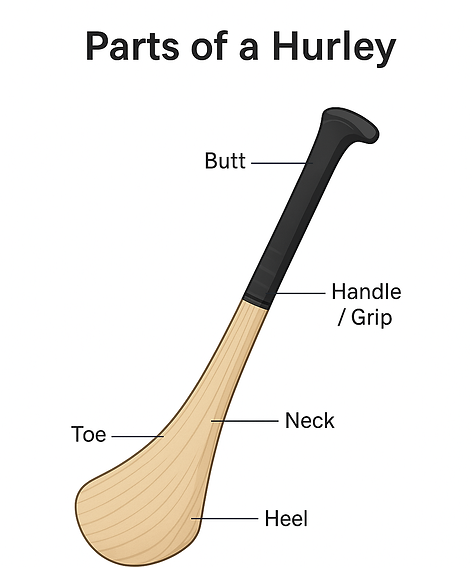

Bas
Butt
The very top end of the hurley. It provides a secure stopping point for the player’s top hand and helps with grip and control during striking, catching, and lifting.
Handle / Grip
The long upper section of the hurley where the player holds it. It is usually wrapped with a rubber or synthetic grip for comfort and better control. This part gives leverage for swinging and striking.
Neck
The narrower section between the bas and the handle. It must be strong and flexible, as it absorbs much of the shock from striking the sliotar. A well-shaped neck improves balance and feel.
Toe
The pointed or rounded end of the bas. It is commonly used when striking on the run, flicking the ball, or lifting the sliotar from the ground.
Heel
The inside lower corner of the bas. It provides stability to the bas and is used in ground hurling, blocking, and angled strikes.

First Touch
Sliotar
is the ball used in the Gaelic games of hurling and camogie. It is similar in size to a tennis ball .

Smart Touch : Go Games

Quick Touch : U10s U11s

Size 4 Match Sliotar

How to Measure for a Hurley
-
Stand up straight with your arms relaxed by your side.
-
Place the hurley beside you, with the heel resting on the ground.
-
The correct length is when the top of the hurley reaches your wrist (the point where your hand meets your arm).
-
If it reaches above the wrist, it’s too long.
-
If it’s below the wrist, it’s too short.
This wrist-height method is the standard and most reliable way to choose the right hurley size.
Height Reference Table (this is a guide):
Player Height Hurley Length
Up to 4’11” (150 cm) 24–26 inches
5’0”–5’3” (152–160 cm) 26–28 inches
5’4”–5’7” (162–170 cm) 28–30 inches
5’8”–5’11” (172–180 cm) 30–34 inches
6’0”+ (183 cm+) 34–36 inches
Grip / Handle – Standard hurley grips fit most hands, but you can wrap the handle for better control. Measure your hand span if you want a custom grip thickness.
How to hold a Hurley
-
Top hand (dominant) near the top of the handle — guides and controls the hurley.
-
Bottom hand (non-dominant) lower on the handle near the bas — gives power.
-
Hands shoulder-width apart, relaxed but firm grip..

-
Stance: knees slightly bent, weight balanced, elbows slightly bent.
-
Swing using arms and shoulders, not just wrists, hitting the sliotar with the flat Heel
Credit :Learning GAA
4-7 years Hurling

Coach Season Planner
Sample
Coach Session Planner
Sample

© 2026 The Duhallow Juvenile Clubs GAA Coaching Website & App. All rights reserved.
Coach Season Planner
Printable Template

TAP TO
OPEN
© 2026 The Duhallow Juvenile Clubs GAA Coaching Website & App. All rights reserved.


© 2026 The Duhallow Juvenile Clubs GAA Coaching Website & App. All rights reserved.
Coach Session Planner
Printable Template

TAP TO
OPEN
© 2026 The Duhallow Juvenile Clubs GAA Coaching Website & App. All rights reserved.
GRIP READY
4-7 years Hurling

-
Top Hand: Near the end of the hurley
-
Bottom Hand: Positioned midway
-
Ready Position: Hurley in front, knees slightly bent, eyes on the sliotar
Key Points


Videos of Additional
Grip Ready Activities
Credit :Naoise Hurling
Credit :Connacht GAA
Credit :Learning GAA
Hurling Grip Ready Checklist
✅ Technique
-
Top hand at end, bottom hand midway
-
Hurley in front, knees bent, eyes on sliotar
-
Controlled, smooth movements
✅ Skill Indicators
-
Holds hurley correctly
-
Maintains balance
-
Eyes on sliotar, ready to act
✅ If Struggling
-
Practice grip and stance separately
-
Start standing still, then combine
-
Encourage small, controlled movements

Credit :Learning GAA
4-7 years Hurling
LOCK & SWING
Key Points
-
Hands locked
-
Wide, balanced stance
-
Eyes on the ball
-
Low, smooth swing
-
Follow through


Videos of Additional
Lock & Swing Activities
Credit :Tramore GAA
Credit :Tramore GAA
Credit: Learning GAA
Credit: Learning GAA
Hurling Lock & Swing
Checklist
✅ Technique
-
Hands locked together on the hurley
-
Shoulders turned sideways to the target
-
Smooth, controlled swing
✅ Skill Indicators
-
Maintains locked hands throughout swing
-
Swings with balance and good posture
-
Eyes on the sliotar during the action
✅ If Struggling
-
Practice locking hands first
-
Use slow-motion swings to build control
-
Break it into steps: lock → turn → swing

4-7 years Hurling
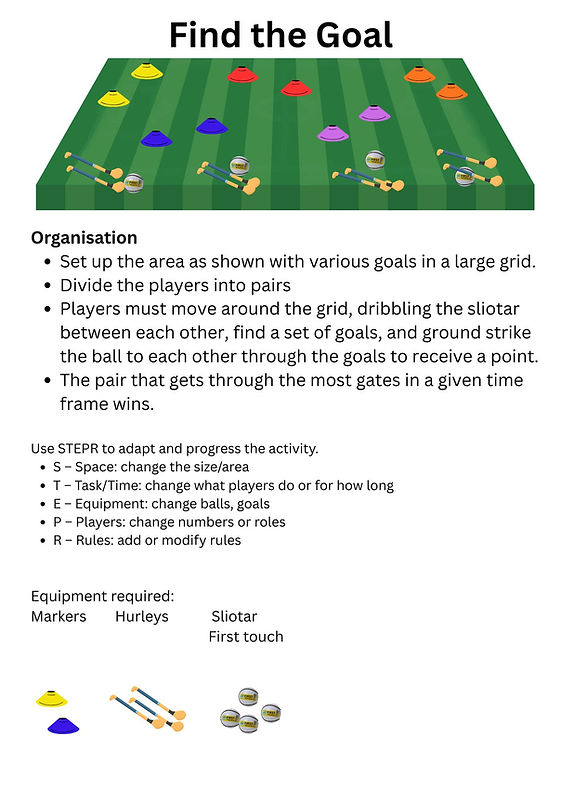
GROUND STRIKE
-
Hands locked
-
Wide, balanced stance
-
Eyes on the ball
-
Low, smooth swing
-
Follow through
Key Points


Videos of Additional
Ground Strike Activities
Credit:CLG Na Fianna
Credit:CLG Na Fianna


Hurling Ground Strike Checklist
✅ Technique
-
Hands locked with hurley held low
-
Eyes on the sliotar on the ground
-
Smooth swing through the ball
✅ Skill Indicators
-
Strikes with balance and control
-
Keeps eyes down until after contact
-
Hurley stays low throughout the swing
✅ If Struggling
-
Practice swinging without a ball first
-
Use a larger or softer ball for confidence
-
Break it into steps: stance → low hurley → swing

Credit: Learning GAA
Credit: Learning GAA
4-7 years Hurling
DRIBBLING
Key Points
-
Hands locked on the hurley
-
Keep the ball close and under control
-
Small, gentle touches
-
Eyes up when possible
-
Move at a steady pace


Videos of Additional
Dribbling Activities
Credit:Tramore GAA
Credit:CLG Na Fianna
Credit: Learning GAA
Hurling Dribbling Checklist
✅ Technique
-
Hurley kept low and close to the ball
-
Small, gentle taps to keep the sliotar moving
-
Eyes on the ball, body balanced
✅ Skill Indicators
-
Keeps control of the sliotar while moving
-
Uses soft, consistent taps
-
Stays balanced and adjusts direction smoothly
✅ If Struggling
-
Start dribbling while standing still
-
Use very small taps at first
-
Set up short straight lines or cones for simple practice

Credit: Learning GAA
4-7 years Hurling
GROUND STOP
-
Bend knees, get low
-
Hands locked on hurley
-
Angle the hurley to block the ball
-
Cushion the sliotar to stop it under control
Key Points


Videos of Additional
Ground Stop Activities
Credit: Tramore GAA
Credit:CLG Na Fianna
Credit: Learning GAA
Hurling Ground Stop Checklist
✅ Technique
-
Hurley held low and flat to the ground
-
Eyes on the sliotar as it approaches
-
Use the hurley face to cushion and stop the ball
✅ Skill Indicators
-
Stops the sliotar cleanly without it bouncing away
-
Keeps the hurley steady and low
-
Maintains balance while stopping the ball
✅ If Struggling
-
Practice stopping a slowly rolled ball first
-
Use a larger or softer ball to build confidence
-
Remind them: “Hurley low, eyes on the ball”

Credit: Learning GAA
RJT RUNNING- JUMPING - THROWING
OBSTACLE COURSE
4-7 years
Movement Skills
🏐 Key Points
-
Running
-
Jumping
-
Dodging/Changing direction
-
Balancing
-
Throwing & catching
-
Stopping and starting
-
Agility and coordination basics

ABC AGILITY - BALANCE- COORDINATION

MULTI DIRECTIONAL RUNNING WITH HURL/ BALL


CHASING GAMES


Videos of Additional
Movement Activities
Credit:Fermoy GAA
Credit:LGFA
Credit: Learning GAA
Credit:Fitspiration
Credit:Colm Nally
Credit: Learning GAA
Movement Skills Checklist
✅ Technique
-
Uses short, controlled steps
-
Keeps knees soft for balance
-
Changes direction smoothly
-
Maintains good posture while moving
-
Looks up and scans the area
✅ Skill Indicators
-
Moves confidently in different directions
-
Stops and starts without losing balance
-
Shows coordination when running, turning, or dodging
-
Maintains control of their body while moving.
✅ If Struggling
-
Slow the movement pattern (walk → jog → run)
-
Use simple games like follow-the-leader or shadowing
-
Add visual cues: “Small steps,” “bend knees,” “eyes up”


© 2026 The Duhallow Juvenile Clubs GAA Coaching Website & App. All rights reserved.
© 2026 The Duhallow Juvenile Clubs GAA Coaching Website & App. All rights reserved.
© 2026 The Duhallow Juvenile Clubs GAA Coaching Website & App. All rights reserved.
Coach Session Planner
Sample
Coach Session Planner
Sample 2
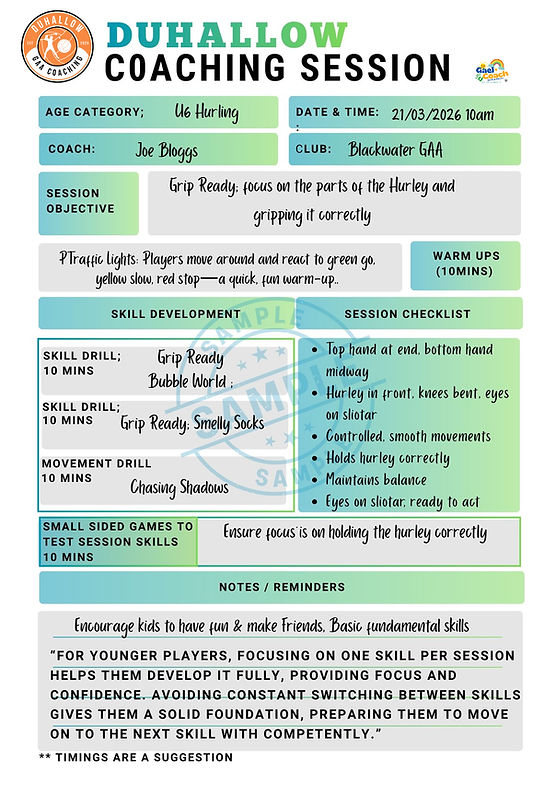
Coach Session Planner
Printable Template


TAP TO
OPEN
8-12 years Football
TAP TO
OPEN
© 2026 The Duhallow Juvenile Clubs GAA Coaching Website & App. All rights reserved.
© 2026 The Duhallow Juvenile Clubs GAA Coaching Website & App. All rights reserved.
Coach Season Planner
Sample

Coach Season Planner
Printable Template

Coach Session Planner
Sample


Coach Session Planner
Printable Template

TAP TO
OPEN
8-12 years Football
PUNT KICK
🏐 Key Points
-
Hold the ball in both hands
-
Drop the ball onto the foot (don’t throw)
-
Point the toe down
-
Kick with the laces
-
Step forward with opposite foot
-
Follow through towards the target.
🗣 Simple cue: “Drop – Toe down – Laces – Follow through!”


Videos of Additional
Kicking Activities
Credit: Learning GAA
Credit: Learning GAA
Credit: Tramore GAA
Credit:Connacht GAA
Credit: Learning GAA
🏐 Punt Kick Checklist
✅ Technique & Rules
-
Keep eyes on the ball.
-
Hold the ball vertically in the hand.
-
Drop the ball straight onto the kicking foot.
-
Strike with the laces (instep).
-
Point the toe down and lock the ankle.
-
Follow through towards the target.
-
Keep balance on the non-kicking foot.
✅ Skill Indicators
-
Can punt kick with consistent height and distance.
-
Can kick accurately to a teammate or target.
-
Uses both left and right foot when encouraged.
-
Maintains balance after the kick.
-
Begins to punt kick on the move.
✅ If the Player Struggles with Punt Kick
-
Practice drop → kick without focusing on distance.
-
Start with short punts, then build up gradually.
-
Use target cones to improve accuracy.
-
Slow the drop if timing is inconsistent.


8-12 years Football
HOOK KICK
🏐 Key Points
-
Drop the ball to the kicking foot side.
-
Strike with the inside of the foot.
-
Eyes on the ball.
-
Follow through toward the target.


Videos of Additional
Kicking Activities
Credit GAA.ie
Credit Tramore GAA
Credit LGFA
Credit:Connacht GAA
Credit: Learning GAA
🏐 Hook Kick Checklist
✅ Technique & Rules
-
Hold the ball in both hands.
-
Drop the ball onto the kicking foot side.
-
Strike the bottom half of the ball with the inside of the foot.
-
Follow through toward the target.
✅ Skill Indicators
-
Makes clean contact with the ball.
-
Ball travels low and accurate.
-
Maintains balance after the kick.
-
Can kick off both left and right foot.
✅ If the Player Struggles
-
Practice the drop without kicking first.
-
Start with short distances.
-
Focus on foot placement and follow-through.
-
Build confidence before increasing distance.
8-12 years Football
SOLO
🏐 Key Points
-
Kick ball into hands while running.
-
Lift ball onto instep → catch with hands → solo every 2–3 steps.
-
Wall solo, cone solo, solo & turn.
-
Tips: Keep eyes on ball, relax, use both feet, start slow.


Videos of Additional
Solo Activities
Credit: Learning GAA
Credit:Connacht GAA
Credit:LGFA
Credit: Learning GAA
Credit: Learning GAA
🏐 Solo Checklist
✅ Technique & Rules
-
Keep eyes on the ball during the drop.
-
Hold the ball securely in one hand.
-
Drop the ball straight onto the foot.
-
Strike with the laces (instep).
-
Catch the ball cleanly at chest height.
-
Take controlled steps between solos.
-
Solo after 4 steps or less.
✅ Skill Indicators
-
Can solo smoothly while moving at speed.
-
Can solo using both left and right foot.
-
Maintains balance and control when turning.
-
Looks up to assess options while soloing.
-
Can solo under light pressure.
✅ If the Player Struggles to Solo
-
Break the skill into drop → kick → catch.
-
Practice stationary solo before adding movement.
-
Use target cones to guide steps and timing.
-
Slow the movement until control improves.
8-12 years Football
FIRST TOUCH
-
Control the ball immediately after receiving it
-
Feet for ground balls, hands for air balls, chest/thigh for high balls.
-
Keep eyes on the ball, relax, direct away from pressure.
-
Wall pass, partner passing, solo movement.
🏐 Key Points


Videos of Additional
First Touch Activities
Credit: Colm Nally:
Credit: Colm Nally:
Credit:Our Game
Credit:Connacht GAA
Credit: Learning GAA
🏐 First Touch
Checklist
✅ Technique & Rules
-
Keep eyes on the ball as it arrives.
-
Get hands ready early in front of the body.
-
Move towards the ball to meet it.
-
Cushion the ball into the hands or chest.
-
Secure the ball before moving on.
✅ Skill Indicators
-
Controls the ball cleanly on first contact.
-
Can receive passes at different heights and speeds.
-
Takes first touch into space.
-
Maintains balance after receiving the ball.
-
Looks up quickly after the first touch.
✅ If the Player Struggles with First Touch
-
Use short, gentle passes to build confidence.
-
Practice ready hands and movement without pressure.
-
Progress from stationary to moving receptions.
-
Use lighter balls if needed, then return to match ball.
8-12 years Football
HAND PASSING
🏐 Key Points
-
Passing the ball using your hand to strike it to a teammate.
-
Hold ball in non-dominant hand.
-
Strike with a closed fist or flat hand from opposite hand.
-
Step into the pass and follow through.
-
Keep it accurate, chest-height, and quick.
-
Partner passing, moving hand-pass drills, pressure passing.

________

Hand Pass
Videos of Additional
Hand Passing Activities
Credit: Learning GAA
Credit:Tramore GAA
Credit:Tramore GAA
Credit: Connacht GAA
Credit: Learning GAA
🏐 Handpass Checklist
✅ Technique & Rules
-
Hold the ball securely in one hand.
-
Make a clear striking action with the other hand.
-
Strike the ball with the flat of the hand.
-
Follow through towards the target.
-
Step forward to add power and accuracy.
-
Handpass must be a clear strike (not a throw).
✅ Skill Indicators
-
Can handpass accurately over short and medium distances.
-
Uses both left and right hand when encouraged.
-
Can handpass while moving.
-
Selects the correct handpass option in games.
-
Maintains balance after the pass.
✅ If the Player Struggles with Handpass
-
Practice stationary handpass first.
-
Focus on strike action (no pushing).
-
Use targets to improve accuracy.
-
Reduce distance, then build gradually.
8-12 years Football
BLOCKING
🏐 Key Points
-
Blocking; : Stopping a kick or handpass.
-
Close down quickly, stay low, extend arm/leg at last moment.
-
Time it right—don’t swing wildly.


Videos of Additional
Blocking Activities
Credit:Tramore GAA
Credit:Clanna Gael Fontenoy
Credit: Connacht GAA
Credit: Learning GAA
🏐 Blocking Checklist
✅ Technique & Rules
-
Keep eyes on the ball, not the player.
-
Stay side-on with knees bent and body low.
-
Time the block as the player kicks or handpasses.
-
Use one arm to block, the other for balance.
✅ Skill Indicators
-
Can block kick or handpass effectively.
-
Maintains balance after contact.
-
Recovers quickly to contest the ball.
-
Shows confidence and correct decision-making.
✅ If the Player Struggles with Blocking
-
Practice shadow defending (no contact).
-
Work on timing and footwork first.
-
Introduce controlled contact gradually.
-
Reinforce rules to build confidence and safety.
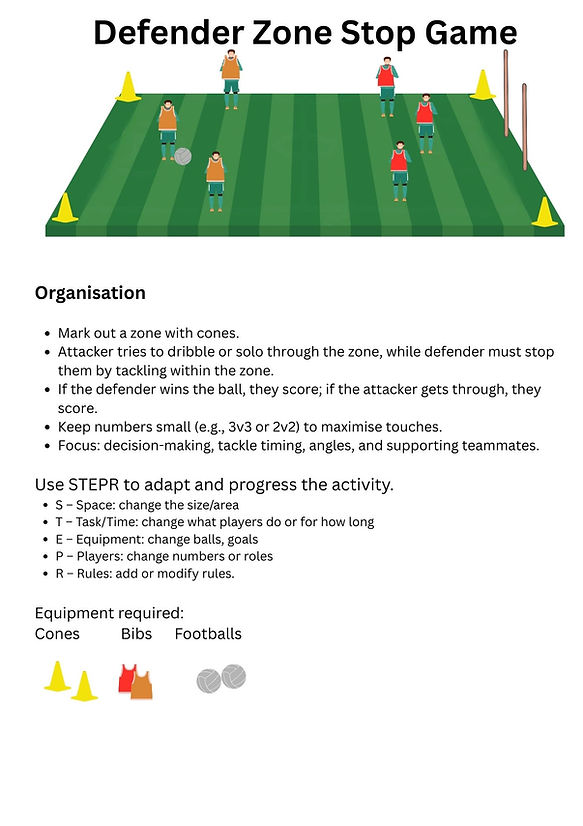
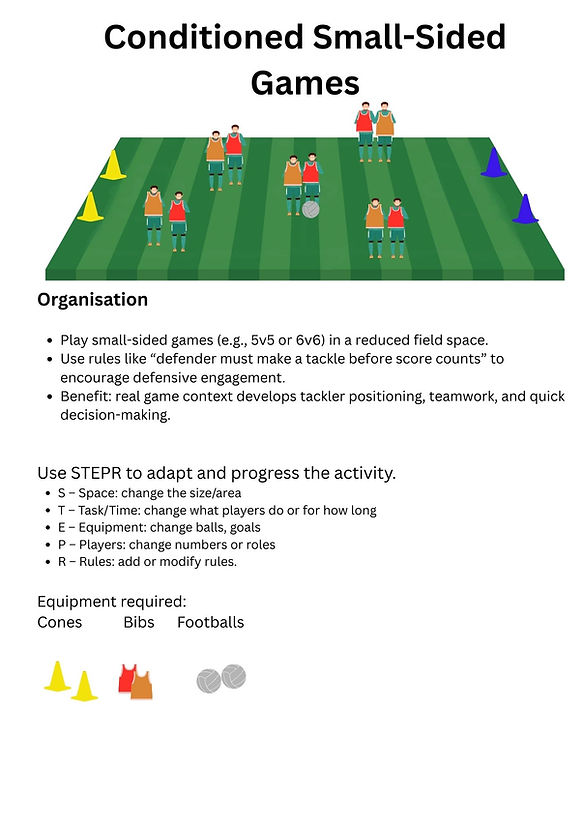
TACKLING
8-12 years Football
🏐 Key Points
Tackling; Dispossessing or delaying an opponent.
-
How: Stay side-on, keep feet moving, use shoulder-to-shoulder contact.
-
Tip: Watch the ball, not the player.


Videos of Additional
Tackling Activities
Credit:Bray Emmets Coaching
Credit: CLG na Fianna
Credit: Learning GAA
Credit: Connacht GAA
Credit: Learning GAA
🏐Tackling Checklist
✅ Technique & Rules
-
Stay on your feet and keep balanced.
-
Approach the opponent from the side or front.
-
Use a near-hand tackle to get the ball (not pulling or pushing).
-
Keep eyes on the ball and follow through toward the ball.
✅ Skill Indicators
-
Makes legal contact with the ball, not the player.
-
Times the tackle when the opponent has to play the ball (solo/bounce).
-
Maintains balance and control after contact.
-
Can slow or stop the opponent safely.
✅ If the Player Struggles
-
Practice tackling movements without the ball first.
-
Use slow, controlled situations to build confidence.
-
Walk through near-hand technique step by step.
-
Gradually add realistic movement and game-like speed
8-12 years Football
HIGH CATCH
🏐 Key Points
-
Catching the ball above head height.
-
Time your jump, extend arms fully, catch at highest point.
-
“W” shape behind the ball, fingers spread.
-
Keep eyes on ball, knee up for protection, land balanced.


Videos of Additional
High Catch Activities
Credit:Connacht GAA
Credit: Learning GAA
Credit: CLG na Fianna
Credit: Connacht GAA
Credit: Learning GAA
🏐 High Catch Checklist
✅ Technique & Rules
-
Keep eyes on the ball from early flight.
-
Judge the flight and move into position.
-
Jump off one foot, raising the opposite knee.
-
Catch the ball at the highest point.
-
Use the “W” hand shape behind the ball.
-
Secure the ball and land balanced.
✅ Skill Indicators
-
Can catch cleanly under little or no pressure.
-
Times jump effectively for high balls.
-
Maintains balance on landing.
-
Can catch while being lightly challenged.
-
Shows confidence attacking the ball.
✅ If the Player Struggles with High Catch
-
Practice overhead throw and catch first.
-
Break down into jump → catch → land.
-
Use soft balls to build confidence.
-
Introduce pressure gradually.
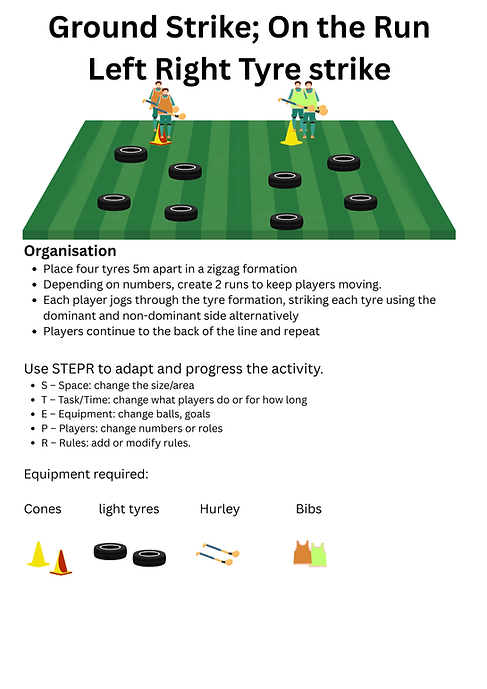
8-12 years Hurling
GROUND STRIKING

Key Points
-
Place the hurley behind the sliotar
-
Keep eyes on the sliotar
-
Use a short swing
-
Strike the sliotar along the ground



Videos of Additional
Ground Striking
Credit: Learning GAA
Credit: Learning GAA
Credit:Connacht GAA
Credit: Learning GAA
8–12 Years Hurling –
Ground Striking Checklist
✅ Technique & Rules
Ground Strike
-
Keep eyes on the sliotar.
-
Place the hurley behind the sliotar.
-
Use a short, controlled swing.
-
Strike the sliotar along the ground toward the target.
✅ Skill Indicators
-
Can strike the sliotar accurately along the ground.
-
Maintains balance and control during strike action.
✅ If the Player Struggles
-
Practice each skill while stationary first.
-
Slow the movement down and focus on technique.
-
Break skills into steps and build them back together.
-
Use repetition and encouragement to build confidence.

8-12 years Hurling
JAB LIFT
Key Points
-
Hold the hurl with a strong bottom hand grip.
-
Turn the bas (toe) of the hurl slightly inward.
-
Slide the bas under the sliotar with a short, sharp jab.
-
Jab under the ball — don’t scoop or flick wildly.
-
Use a quick wrist action.
-
Lift the sliotar smoothly into the hand.
-
Keep control — the ball should come up in front of you.


Videos of Additional
Jab Lift Activities
Credit: Learning GAA
Credit: Learning GAA
Credit: Connacht GAA
Credit: Learning GAA
8–12 Years Hurling –
Jab lift Checklist
✅ Technique & Rules
Jab Lift Hold the hurley with a strong grip.
-
Keep the hurley low to the ground.
-
Jab the sliotar forward, not upwards
-
Follow through in the direction of the target.
✅ Skill Indicators
-
Can jab the sliotar forward under control.
-
Maintains balance and control during the skill.
✅ If the Player Struggles
-
Practice each skill while stationary first.
-
Slow the movement down and focus on technique.
-
Break skills into steps and build them back together.
-
Use repetition and encouragement to build confidence.
8-12 years Hurling
ROLL LIFT
Key Points
-
Hold the hurl with two hands for control.
-
Place the bas (toe) of the hurl behind the sliotar.
-
Keep the hurl low to the ground.
-
Gently roll the sliotar up the bas of the hurl.
-
Use a smooth lifting motion — not a flick.
-
Guide the ball into your hand at about waist height.
-
Stay balanced throughout.


Videos of Additional
Roll Lift Activities
Credit: Learning GAA
Credit: Learning GAA
Credit:Connacht GAA
Credit: Learning GAA
8–12 Years Hurling –
Roll Lift Checklist
✅ Technique & Rules
Roll Lift
-
Place the hurley flat on the ground.
-
Roll the sliotar onto the bas of the hurley.
-
Bend knees to stay balanced.
-
Lift smoothly into the hand.
✅ Skill Indicators
-
Can perform a roll lift while moving slowly.
-
Maintains balance and control during each skill.
✅ If the Player Struggles
-
Practice each skill while stationary first.
-
Slow the movement down and focus on technique.
-
Break skills into steps and build them back together.
-
Use repetition and encouragement to build confidence.
8-12 years Hurling
FIRST TOUCH
Key Points
-
First Touch
-
Keep eyes on the sliotar
-
Soft hands and relaxed grip
-
Cushion the sliotar into control
-
Move into space after the first touch


Videos of Additional
First Touch Activities
8–12 Years Hurling –
First Touch Checklist
✅ Technique & Rules
-
Keep eyes on the sliotar
-
Relax the grip and use soft hands
-
Cushion the sliotar into control
-
Move into space after the first touch
✅ Skill Indicators
-
Controls the sliotar on first contact
-
Keeps the sliotar close to the body
-
Moves forward after the first touch
-
Maintains balance while receiving
✅ If the Player Struggles
-
Practice stationary controls first
-
Use short, gentle feeds
-
Slow the drill down
-
Build confidence before adding pressure
Credit: Dublin GAA Coach
Credit:Dublin GAA Coach
Credit: Hurling Drills
Credit:Wexford GAA
Credit: Connacht GAA
Credit: Learning GAA
8-12 years Hurling
HOOKING
Key Points
-
Approach from the side or slightly behind
-
Keep eyes on the hurley, not the sliotar
-
Hook the opponent’s hurley, not their arms
-
Maintain balance and correct body position


Videos of Additional
Hooking Activities
Credit: Naoise Hurling
Credit: Monharps hurling clg
Credit: All Saints GAA
Credit:Connacht GAA
8–12 Years Hurling –
Hooking Checklist
✅ Technique & Rules
-
Approach from the side or slightly behind
-
Focus on the opponent’s hurley
-
Hook the hurley, not the arms
-
Maintain balance and control
✅ Skill Indicators
-
Times the hook correctly
-
Uses safe body position
-
Regains balance quickly
-
Applies the skill in games
✅ If the Player Struggles
-
Practice the movement without a sliotar
-
Walk through the skill slowly
-
Use a cooperative partner
-
Gradually increase pace

Credit: Learning GAA

8-12 years Hurling
BLOCKING
Key Points
-
Stay low with knees bent
-
Present the bas of the hurley to the ball
-
Keep head and eyes up
-
Recover quickly after the block


Videos of Additional
Blocking Activities
Credit: Naoise Hurling
Credit: Naoise Hurling
Credit: Learning GAA
Credit: Learning GAA
8–12 Years Hurling –
Blocking Checklist
✅ Technique & Rules
-
Stay low with knees bent
-
Present the bas of the hurley
-
Keep head up and eyes forward
-
Absorb contact and recover quickly
✅ Skill Indicators
-
Stops or deflects the sliotar
-
Maintains balance on contact
-
Recovers quickly to play on
-
Shows confidence when blocking
✅ If the Player Struggles
-
Start with slow, controlled strikes
-
Practice block position without a sliotar
-
Reduce distance and speed
-
Reinforce correct technique and bravery
Credit: Connacht GAA
Credit: Learning GAA

8-12 years Hurling
CATCHING
Key Points
-
Keep eyes on the sliotar
-
Move feet to get in line with the ball
-
Reach out and catch at the highest point
-
Cushion the sliotar into the hand


Videos of Additional
Catching Activities
Credit: All Saints GAA
Credit:The Ultimate Explainer
Credit: Learning GAA
Credit:Connacht GAA
Credit: Learning GAA
8–12 Years Hurling
Catching Checklist
✅ Technique & Rules
-
Keep eyes on the sliotar
-
Move feet to get in line with the ball
-
Catch at the highest point possible
-
Cushion the sliotar into the hand
✅ Skill Indicators
-
Catches the sliotar cleanly
-
Uses correct hand position
-
Maintains balance when catching
-
Can catch while moving
✅ If the Player Struggles
-
Practice stationary throws and catches
-
Use short, gentle feeds
-
Focus on hand position first
-
Gradually add movement

8-12 years Hurling
SOLOING
Key Points
-
Balance the sliotar on the bas of the hurley
-
Keep the hurley close to the body
-
Tap the sliotar gently and under control
-
Look up occasionally while soloing


Videos of Additional
Solo Activities
Credit:Eamonn GAA
Credit: Eamonn GAA
Credit: CLG na Fianna
Credit:Connacht GAA
8–12 Years Hurling
Solo Checklist
✅ Technique & Rules
-
Balance the sliotar on the bas of the hurley
-
Keep the hurley close to the body
-
Tap the sliotar gently and under control
-
Keep eyes on the sliotar, look up occasionally
✅ Skill Indicators
-
Maintains control while soloing
-
Can solo at walking or jogging pace
-
Keeps the sliotar close to the hurley
-
Shows awareness while moving
✅ If the Player Struggles
-
Practice balancing the sliotar while stationary
-
Use short solo taps first
-
Slow the movement down
-
Build confidence before increasing speed
Credit: Learning GAA
8-12 years Movement Skills
ABC AGILITY - BALANCE- COORDINATION
RJT RUNNING- JUMPING - THROWING
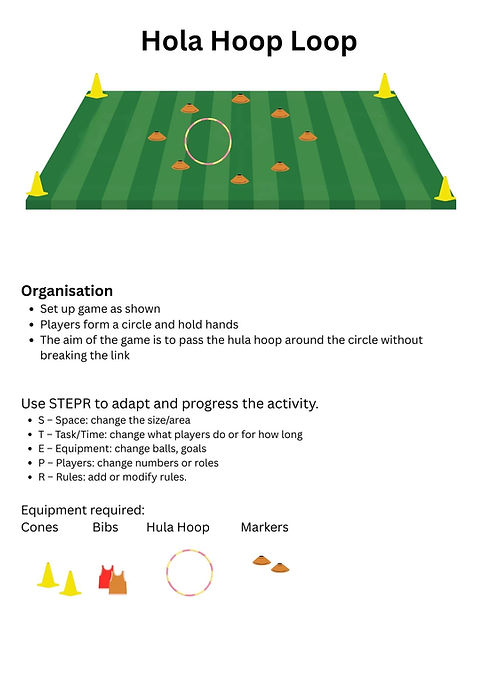
OBSTACLE COURSE

CHASING GAMES


Videos of Additional
Movement Activities
Credit:Leinster GAA
Credit:360 Player
Credit:Fitspiration
Credit:GazGaelic Guide
Credit Connacht GAA
Credit: Learning GAA
8–12 Years Hurling –
Blocking Checklist
✅ Technique & Rules
-
Stay low with knees bent
-
Present the bas of the hurley
-
Keep head up and eyes forward
-
Absorb contact and recover quickly
✅ Skill Indicators
-
Stops or deflects the sliotar
-
Maintains balance on contact
-
Recovers quickly to play on
-
Shows confidence when blocking
✅ If the Player Struggles
-
Start with slow, controlled strikes
-
Practice block position without a sliotar
-
Reduce distance and speed
-
Reinforce correct technique and bravery
MULTI DIRECTIONAL RUNNING WITH HURL/ BALL

13-15 years Football
LONG KICK
Key Points:
-
Body & Balance: Plant non-kicking foot beside ball, lean slightly forward, stay stable.
-
Foot Contact: Strike with instep (laces), hit center for straight flight, follow through fully.
-
Leg Power: Use a moderate run-up, rotate hips, drive knee through for distance.
-
Accuracy: Pick a target, control ball height, practice consistently.
-
Drills: Distance kicks, target cones, partner pass practice. ** Bilateral kicking


Videos of Additional
Long Kick Activities
Credit: Gaelic Keeper Coach
Credit: Learning GAA
Credit:David Mc Caffrey
Credit: Learning GAA
Long Kick Checklist
✅ Technique & Rules
-
Hold the ball firmly with both hands.
-
Drop the ball onto the kicking foot side.
-
Strike the ball with the laces of the boot.
-
Plant the non-kicking foot beside the ball.
-
Follow through toward the target.
✅ Skill Indicators
-
Kicks the ball long with good height and distance.
-
Maintains balance after the kick.
-
Shows accuracy toward a target or teammate.
-
Can kick confidently off both left and right foot (bilateral kicking).
✅ If the Player Struggles
-
Practice the drop and contact without power first.
-
Start with shorter kicks and increase distance gradually.
-
Focus on body position and follow-through.
-
Practice equal repetitions with both feet to develop bilateral ability.
Credit: Gaelic Keeper Coach
Tip: At 13–15 years, players are still growing, so gradual strength training (core, legs, and hips) and proper technique are more important than just trying to kick as hard as possible.
13-15 years Football
PASS TO MOVING TARGET
Key Points:
-
Keep head up to see the moving teammate.
-
Step into the kick with the non-kicking foot beside the ball.
-
Lead the pass in front of the runner.
-
Strike the ball with the laces.
-
Follow through toward the target.
-
Practice kicking with both left and right foot (bilateral kicking).


Videos of Additional
Pass to Moving Target Activities
Credit:Marty Clarke
Credit: Kieran Mc Geary
Credit:David Mc Caffrey
Credit: Learning GAA
🏐 13–15 GAA Football – Pass to Moving Target Checklist
✅ Technique & Rules
-
Keep head up to identify the moving teammate.
-
Step into the kick with the non-kicking foot beside the ball.
-
Strike the ball with the laces toward the player’s path.
-
Lead the pass in front of the runner, not at their feet.
-
Practice kicking with both left and right foot (bilateral kicking).
✅ Skill Indicators
-
Pass reaches the teammate in stride.
-
Shows accuracy and timing with the pass.
-
Maintains balance and control after kicking.
-
Can pass effectively using either foot.
✅ If the Player Struggles
-
Start with slow-moving targets.
-
Reduce distance to focus on accuracy first.
-
Practice equal repetitions on both feet.
-
Gradually increase speed and distance of the pass.
Credit: Total GAA Coach
Tip: At 13–15 years, players are still growing, so gradual strength training (core, legs, and hips) and proper technique are more important than just trying to kick as hard as possible.
13-15 years Football
SHOOTING ON THE RUN/
AT ANGLES
Key Points:
-
Balance and body control are crucial.
-
Plant foot correctly and align with target.
-
Decide early, shoot quickly, and follow through.
-
Practice from multiple angles under pressure.
-
Repeat often for muscle memory.


Videos of Additional
Shooting on the Run Activities
Credit:Gaz Gaelic Guide
Credit:David Mc Caffrey
Credit: Learning GAA
🏐 13–15 GAA Football Shooting on the Run / at Angles Checklist
✅ Technique & Rules
-
Keep head up and eyes on the target while running.
-
Approach the ball in stride, maintaining balance.
-
Plant non-kicking foot beside the ball, pointing toward the target.
-
Strike with instep for power or side-foot for placement.
-
Follow through toward the goal, even when shooting from an angle.
-
Adjust body slightly open to target when shooting from wide angles.
-
Decide early whether to shoot or pass while on the run.
-
Practice with both left and right foot (bilateral kicking) to improve versatility.
✅ Skill Indicators
-
Ball reaches target with accuracy and pace.
-
Maintains balance and control during and after the kick.
-
Can shoot effectively from different angles and while moving.
-
Demonstrates quick decision-making under pressure.
✅ If the Player Struggles
-
Start with slow runs and close-range shots.
-
Practice shooting from wide angles before increasing difficulty.
-
Focus on planting foot and body alignment before adding speed.
-
Repeat shots with both left and right foot to develop versatility.
-
Gradually increase distance, speed, and complexity of drills.
Credit: Total GAA Coach
Tip: At 13–15 years, players are still growing, so gradual strength training (core, legs, and hips) and proper technique are more important than just trying to kick as hard as possible.

13-15 years Football
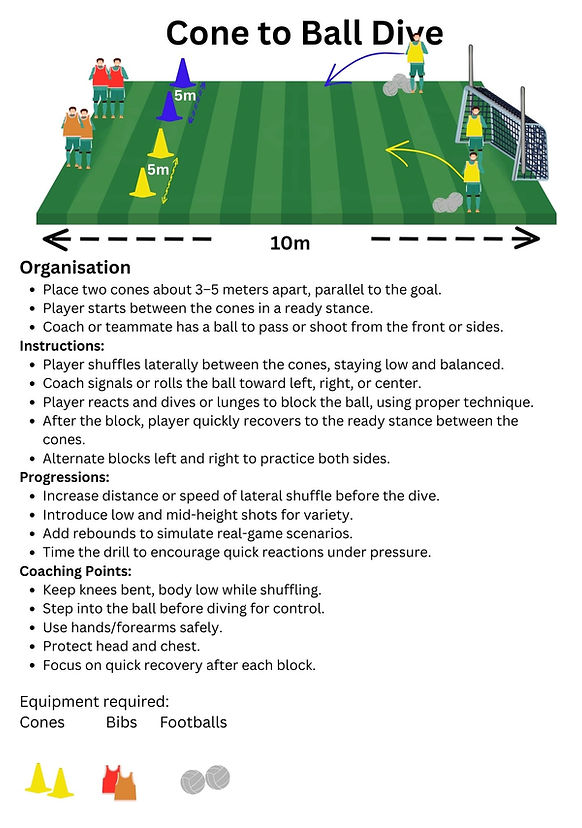
DIVING BLOCK
Key Points:
-
Keep eyes on the ball.
-
Stay low with knees bent for quick reaction.
-
Step into position before diving.
-
Dive or lunge only when needed.
-
Use hands/forearms to block safely.
-
Protect your head and chest.
-
Recover quickly after the block.
-
Practice dives both left and right.



Videos of Additional
Diving Block Activities
Credit:Kiklix
Credit: Learning GAA
🏐 13–15 GAA Football – Diving Block Checklist
✅ Technique & Rules
-
Keep eyes on the ball at all times.
-
Bend knees slightly and stay low to react quickly.
-
Step toward the ball with the lead foot to adjust position.
-
Dive or lunge only when necessary to intercept or block a shot.
-
Use hands and forearms to stop the ball, keeping elbows slightly bent.
-
Protect yourself by tucking your head and keeping chest forward.
-
Return to a ready stance immediately after the block.
✅ Skill Indicators
-
Intercepts or blocks the ball cleanly.
-
Maintains balance and control after diving.
-
Reacts quickly to different ball trajectories.
-
Can execute blocks on both sides (left and right) effectively.
✅ If the Player Struggles
-
Start with slow-moving balls to build confidence.
-
Practice dive technique onto soft mats before doing it on grass.
-
Break the skill into steps: positioning → lunge → block → recover.
-
Gradually increase speed, angle, and distance of incoming balls.
-
Encourage both-side diving to develop bilateral reaction skills.
Credit: Spark GAA
Tip: At 13–15 years, players are still growing, so gradual strength training (core, legs, and hips) and proper technique are more important than just trying to kick as hard as possible.
13-15 years Football
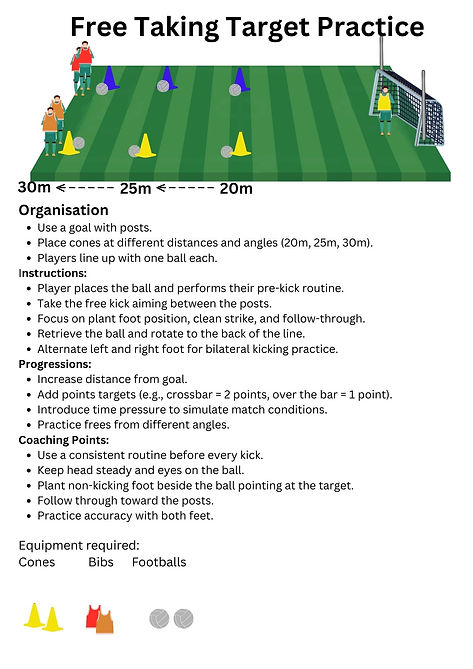
FREE TAKING
Key Points:
-
Use a consistent routine before each kick.
-
Keep eyes on the ball and target.
-
Plant non-kicking foot beside the ball pointing at the posts.
-
Strike the ball cleanly with the laces or inside of the foot.
-
Follow through toward the target.
-
Maintain good balance and body control.
-
Focus on accuracy before power.
-
Practice bilateral kicking (both left and right foot).


Videos of Additional
Free Taking Activities
Credit:Seanie O Shea
Credit: Learning GAA
🏐 13–15 GAA Football –
Free Taking Checklist
✅ Technique & Rules
-
Place the ball correctly on the ground or tee.
-
Take a consistent number of steps back before the kick.
-
Keep eyes on the target before striking.
-
Plant non-kicking foot beside the ball, pointing at the target.
-
Strike the ball with the laces for distance or inside of the foot for accuracy.
-
Follow through toward the posts after the kick.
-
Practice bilateral kicking (both left and right foot).
✅ Skill Indicators
-
Ball travels accurately between the posts.
-
Shows consistent routine before each kick.
-
Maintains balance and control during the strike.
-
Demonstrates good distance and accuracy.
-
Comfortable kicking with either foot.
✅ If the Player Struggles
-
Start with shorter distance frees.
-
Focus on plant foot position and body alignment.
-
Practice the same routine each time.
-
Increase distance gradually as accuracy improves.
-
Practice equal repetitions with both feet to develop bilateral kicking.
Credit:Dublin GAA
Tip: At 13–15 years, players are still growing, so gradual strength training (core, legs, and hips) and proper technique are more important than just trying to kick as hard as possible.
13-15 years Football
GAME BASED TRAINING
-
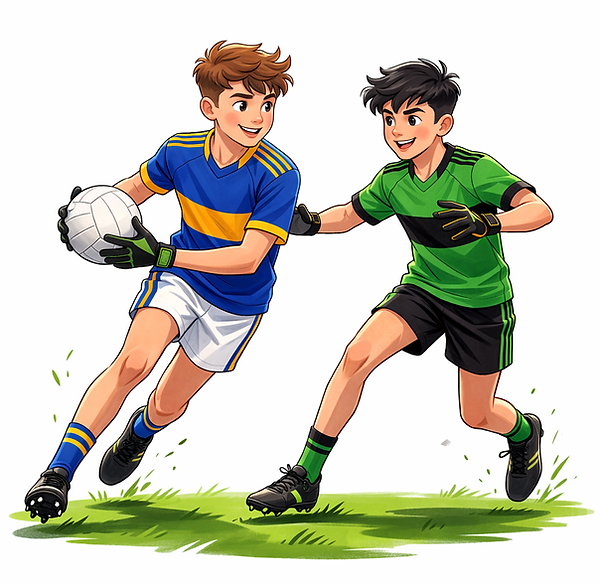
Game-based training means practicing skills through small-sided games and match-like situations rather than only isolated drills. This approach is very effective for young players.
-
For 13–15-year-old players, game-based training helps bridge the gap between drills and real matches, developing skills, decision-making, teamwork, and enjoyment of the game.
Videos of Additional
Free Taking Activities
Credit:Monaghan GAA
Credit: Learning GAA
🏐 13–15 GAA Football –
Game-Based Training Checklist
✅ Technique & Rules
-
Use small-sided games to practice skills.
-
Encourage passing, catching, and shooting in game situations.
-
Promote movement into space to support teammates.
-
Encourage decision-making (pass, solo, or shoot).
-
Allow players to use both feet for kicking and passing (bilateral skills).
-
Keep games competitive but fun.
✅ Skill Indicators
-
Players make quick decisions during play.
-
Demonstrates accurate passing and shooting under pressure.
-
Shows good teamwork and communication.
-
Moves into space to support teammates.
-
Uses both left and right foot during the game.
✅ If the Player Struggles
-
Use smaller teams (3v3 or 4v4) to increase involvement.
-
Reduce pitch size to help decision-making.
-
Add simple rules (e.g., 3 passes before scoring).
-
Encourage equal use of both feet.
-
Provide coaching feedback during breaks.
Credit:Alan Mullins
Tip: At 13–15 years, players are still growing, so gradual strength training (core, legs, and hips) and proper technique are more important than just trying to kick as hard as possible.
✅ Key Benefits
-
Improves Decision Making
Players learn when to pass, shoot, or carry the ball in real match situations. -
Develops Game Awareness
Helps players understand space, movement, and positioning during play. -
Applies Skills Under Pressure
Skills like kicking, catching, and tackling are practiced while being challenged by opponents. -
Increases Player Engagement
Game-based activities are more fun and motivating for teenagers. -
Encourages Teamwork & Communication
Players learn to support teammates and work as a unit. -
Improves Fitness Naturally
Running, changing direction, and reacting in games develop match-specific fitness. -
Builds Confidence
Players gain confidence by using their skills successfully in game situations. -
Supports Bilateral Skill Development
Players naturally practice kicking and passing with both feet during games.
🏐 Game-Based Training Techniques (13–15 GAA Football)
-
Small-Sided Games – Use games like 3v3, 4v4, or 5v5 to increase touches and involvement.
-
Conditioned Games – Add simple rules such as 3 passes before scoring or weaker foot scores worth double.
-
Directional Games – Play with goals or target zones so players must attack and defend realistically.
-
Overload / Underload Games – Create situations like 4 attackers vs 3 defenders to develop decision-making.
-
Transition Games – Focus on quick switching from attack to defence after possession changes.
-
Target Player Games – Use a neutral or target player to encourage movement and support play.
-
Time-Limited Games – Short 30–60 second rounds to increase intensity and decision-making speed.
-
Zone Games – Divide the pitch into zones to encourage spreading out, movement, and positional awareness.
-
Keep-Ball Games – Teams try to maintain possession with quick passing and movement.
-
End-Zone Games – Instead of posts, players score by carrying or passing into an end zone, encouraging support runs.
-
Numbers Game – Coach calls a number (e.g., 3v3 or 4v4) and players quickly enter the pitch to play.
-
Wave Games – One team attacks, then the next group immediately counterattacks after a shot or turnover.
-
Turnover Games – When possession changes, teams must quickly switch from defence to attack.


Key Focus Areas
-
Skill application in match-like situations
-
Quick, accurate decision-making
-
Awareness of space and teammates
-
Team communication and support
-
Balanced use of both feet

13-15 years Hurling
HAND-PASS FROM STICK
Key Points:
-
Keep eyes on the sliotar.
-
Balance sliotar on the bas of the hurley.
-
Step toward the target.
-
Strike with an open hand.
-
Follow through toward teammate.
-
Maintain balance and control.
-
Practice on both left and right sides.


Videos of Additional
Hand-Pass from Stick Activities
Credit:Tramore GAA
Credit: Learning GAA
13–15yrs Hurling –
Hand-Pass from Stick Checklist
✅ Technique & Rules
-
Hold the hurley firmly with dominant hand on top.
-
Balance the sliotar on the bas (flat part) of the hurley.
-
Keep eyes on the sliotar throughout the skill.
-
Step toward the target with the opposite foot.
-
Use an open hand to strike the sliotar from the hurley.
-
Follow through toward the target after the pass.
-
Practice using both left and right side (bilateral skill development).
✅ Skill Indicators
-
Hand pass travels accurately to a teammate.
-
Maintains control of the sliotar before striking.
-
Demonstrates good balance and coordination.
-
Can perform the skill while moving.
-
Comfortable using both sides when passing.
✅ If the Player Struggles
-
Start stationary before progressing to movement.
-
Use a larger or softer sliotar for confidence.
-
Reduce passing distance to focus on technique.
-
Practice the hand strike action separately first.
-
Encourage equal practice on both sides.
Credit:Naoise Training

Tip: At 13–15 years, players are still growing, so gradual strength training (core, legs, and hips) and proper technique are more important than just trying to play as hard as possible.
13-15 years Hurling
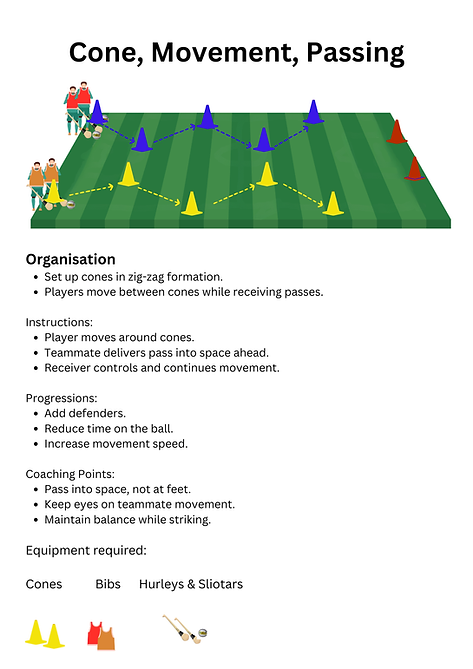
PASS TO MOVING TARGET
Key Points:
-
Keep head up before passing.
-
Lead the pass into space.
-
Step toward the target.
-
Strike smoothly and follow through.
-
Focus on timing and accuracy.
-
Maintain balance while moving.
-
Practice passing on both sides.


Videos of Additional
Pass to Moving Target Activities
Credit:Seanie O Shea
Credit: Learning GAA
13–15yrs Hurling –
Pass to Moving Target Checklist
✅ Technique & Rules
-
Keep head up to identify the moving teammate.
-
Grip the hurley correctly with relaxed hands.
-
Strike through the sliotar with controlled technique.
-
Lead the pass into the teammate’s path, not directly at them.
-
Step toward the target during the strike.
-
Follow through toward the direction of the pass.
-
Practice passing on both left and right sides (bilateral striking).
✅ Skill Indicators
-
Pass reaches teammate in stride.
-
Shows good timing and accuracy.
-
Maintains balance and control after passing.
-
Communicates effectively with teammates.
-
Comfortable passing on both sides.
✅ If the Player Struggles
-
Begin with slow-moving targets.
-
Reduce passing distance.
-
Practice stationary passing first.
-
Use cones to guide movement patterns.
-
Encourage equal practice on both sides.
Credit:Naoise Hurling
Tip: At 13–15 years, players are still growing, so gradual strength training (core, legs, and hips) and proper technique are more important than just trying to play as hard as possible.
13-15 years Hurling
FIRST TOUCH CONTROL
Key Points:
-
Keep eyes on the sliotar.
-
Use soft hands and relaxed grip.
-
Cushion the sliotar on contact.
-
Stay balanced with knees bent.
-
Direct first touch into space.
-
Prepare quickly for next action.
-
Practice control on both sides.


Videos of Additional
First touch Control Activities
Credit:Dublin GAA
Credit: Learning GAA
13–15yrs Hurling –
First Touch Control Checklist
✅ Technique & Rules
-
Keep eyes on the sliotar at all times.
-
Hold the hurley with a balanced grip and soft hands.
-
Cushion the sliotar on contact to control it smoothly.
-
Position body behind the sliotar when receiving.
-
Keep knees slightly bent for balance and quick movement.
-
Direct the first touch into space for the next action.
-
Practice controlling on both left and right sides (bilateral skill development).
✅ Skill Indicators
-
Controls the sliotar cleanly on first touch.
-
Maintains balance and body control.
-
Keeps possession under pressure.
-
Moves smoothly into the next action (pass, solo, or shot).
-
Comfortable controlling on both sides.
✅ If the Player Struggles
-
Start with slow, short passes.
-
Use larger space and less pressure.
-
Practice stationary control before moving.
-
Break skill into stages: watch → cushion → control → move.
-
Encourage equal repetitions on both sides.
Credit:Crecora/Manstar GAA
Tip: At 13–15 years, players are still growing, so gradual strength training (core, legs, and hips) and proper technique are more important than just trying to play as hard as possible.
13-15 years Hurling
FREE TAKING/ SIDE-LINES
Key Points:
-
Keep eyes on the sliotar.
-
Use a balanced grip and stance.
-
Strike smoothly through the sliotar.
-
Step toward the target.
-
Follow through fully.
-
Focus on accuracy before power.
-
Practice striking on both sides.


Videos of Additional
Free Taking/ Side-lines Activities
Credit:Naoise Hurling
Credit: Learning GAA
13–15yrs Hurling –
Free taking/ Sidelines
Checklist
✅ Technique & Rules
-
Place the sliotar correctly for the free or sideline.
-
Grip the hurley firmly with balanced hand position.
-
Keep eyes on the sliotar during the strike.
-
Step toward the target with balanced body position.
-
Strike through the sliotar with a smooth swing.
-
Follow through fully toward the target area.
-
Practice striking from both left and right sides (bilateral striking).
✅ Skill Indicators
-
Strikes the sliotar accurately and consistently.
-
Demonstrates good distance and height control.
-
Maintains balance throughout the strike.
-
Uses proper technique under pressure.
-
Comfortable striking from both sides.
✅ If the Player Struggles
-
Begin with shorter distances.
-
Practice stationary striking before adding pressure.
-
Focus on grip and body positioning.
-
Use target zones to improve accuracy.
-
Encourage equal repetitions on both sides.
Credit:SD Skillset
Tip: At 13–15 years, players are still growing, so gradual strength training (core, legs, and hips) and proper technique are more important than just trying to play as hard as possible.
13-15 years Hurling
GAME BASED TRAINING
-
Game-based training means practicing skills through small-sided games and match-like situations rather than only isolated drills. This approach is very effective for young players.
-
For 13–15-year-old players, game-based training helps bridge the gap between drills and real matches, developing skills, decision-making, teamwork, and enjoyment of the game.
Videos of Additional
Game based Activities
Credit:Hurling Drills
Credit: Learning GAA
13–15 GAA Hurling –
Game-Based Training Checklist
✅ Technique & Rules
-
Use small-sided games to develop skills in match situations.
-
Encourage constant movement and support play.
-
Promote quick decision-making (pass, strike, solo, or shoot).
-
Encourage use of both left and right sides (bilateral striking and control).
-
Include attacking and defending in every activity.
-
Keep games competitive, realistic, and enjoyable.
✅ Skill Indicators
-
Players make quick and effective decisions.
-
Demonstrates accurate passing and striking under pressure.
-
Shows good teamwork and communication.
-
Moves into space to support teammates.
-
Uses both sides confidently during play.
-
Maintains possession and reacts quickly to turnovers.
✅ If the Player Struggles
-
Reduce team numbers (e.g., 3v3 instead of 5v5).
-
Make playing area smaller or simpler.
-
Add simple rules to slow the game down.
-
Allow extra time or touches on the sliotar.
-
Encourage equal practice on both sides.
-
Provide coaching feedback during breaks in play.
Credit:GAA.ie
Tip: At 13–15 years, players are still growing, so gradual strength training (core, legs, and hips) and proper technique are more important than just trying to play as hard as possible.
✅ Key Benefits
-
Improves decision-making in realistic match situations.
-
Develops game awareness and positioning.
-
Encourages players to apply skills under pressure.
-
Increases touches on the sliotar through small-sided games.
-
Builds communication and teamwork.
-
Develops match-specific fitness naturally.
-
Improves reaction speed and anticipation.
-
Encourages creativity and problem-solving.
-
Keeps players engaged, motivated, and enjoying training.
-
Supports bilateral striking and control skills.
-
Helps players transfer skills from training into matches.
-
Allows coaches to provide real-time feedback in game situations.
Game-Based Training Techniques (13–15 Hurling)
-
Small-Sided Games – 3v3, 4v4, or 5v5 to increase touches and involvement.
-
Conditioned Games – Add rules such as “3 passes before scoring” or “weaker side scores count double”.
-
Possession Games – Teams keep possession using quick passing and movement.
-
Directional Games – Teams attack and defend goals or target zones in realistic match play.
-
Transition Games – Focus on switching quickly from attack to defence after turnovers.
-
Overload Games – Create numerical advantages (e.g., 4 attackers vs 3 defenders).
-
End-Zone Games – Score by carrying or passing the sliotar into an end zone.
-
Target Player Games – Use a neutral player to encourage support play and movement.
-
Touch-Limit Games – Restrict touches to improve quick decision-making and fast play.
-
Zone Games – Divide the pitch into sections to improve spacing and positioning.
-
Wave Games – Continuous attacking and defending with teams rotating quickly.
-
Numbers Call Games – Coach calls numbers and players quickly enter to create game scenarios.
-
Weaker Side Challenges – Extra points for scores or passes using the weaker side.
-
Time-Limited Games – Short, intense games to develop speed, reactions, and fitness.
-
Score & Defend Games – After scoring, teams immediately transition to defence.


Key Focus Areas
-
Skill application in match-like situations
-
Quick, accurate decision-making
-
Awareness of space and teammates
-
Team communication and support
-
Balanced use of both hands


