
_edited.png)
13-15 years Football
The 13-15 age group is a crucial time in a young football player's journey. At this stage, the focus shifts to enhancing skills, teamwork and strategic understanding, all within a positive and supportive atmosphere. Players are encouraged to refine their technical abilities, including passing, shooting, dribbling, and defending, while also developing physical attributes like and endurance. The goal is to cultivate a passion for the game and build a strong foundation for future success on and off the field.
Coach Season Planner
Sample

Coach Season Planner
Printable Template
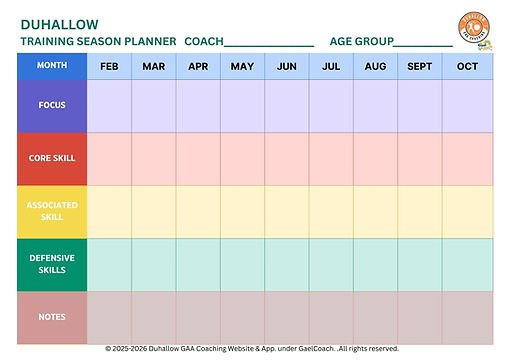

TAP TO
OPEN
Coach Session Planner
Sample

Coach Session Planner
Printable Template
TAP TO
OPEN
GAA Football Rules for Ages 13-15 years
For players aged 13–15, the rules of Gaelic Athletic Association (GAA) football are designed to help young players develop their skills, teamwork, and understanding of the game while playing in a safe and enjoyable environment. At this level, players begin to follow many of the standard rules used in adult football, including passing, tackling, scoring, and positioning on the field. The game encourages speed, skill, and decision-making, while also promoting respect for teammates, opponents, and referees. Learning the rules helps players play fairly, improve their abilities, and enjoy the fast-paced and exciting sport of Gaelic football. 🏐🏃♂️

GAA Football Rules for Ages 13-15 years
3. Equipment & Safety
-
Players must wear standard football boots, jersey, shorts and socks.
-
Mouthguards are compulsory in all Gaelic football games for player safety.
-
Referees monitor the game to ensure safe tackling and fair play.
4. Contact & Physical Play
-
Shoulder-to-shoulder contact is allowed when competing for the ball.
-
Tackling must be fair and controlled, focusing on dispossessing the ball rather than the player.
-
Dangerous or reckless challenges are penalised to protect player safety.
5. Playing the Ball
Players are expected to perform the core football skills confidently:
-
Soloing (bouncing or toe-tapping the ball while running)
-
Hand passing using the fist
-
Kicking from the hands or ground
-
Catching high balls
-
Passing and shooting accurately
Players may take four steps with the ball before soloing or passing.
1. Game Format
-
Games begin to follow the full Gaelic football rules more closely as players prepare for adult football.
-
Teams usually play 15 vs 15 on a full-sized pitch, depending on club numbers and competition structure.
-
Games are played as part of organised leagues and championships, helping players experience structured competition.
2. Playing Time
-
Matches are generally played in two halves, usually between 20–25 minutes per half depending on the competition.
-
Substitutions are allowed, but coaches are encouraged to ensure all players receive meaningful game time.
🔴
🔴
🟢
6. Scoring
-
A goal (ball into the net) = 3 points
-
A point (ball over the crossbar) = 1 point
Scores are officially recorded and contribute to league tables and competitions.
7. Restarts
-
Games begin with a throw-in by the referee at midfield.
-
Kick-outs restart play after a score or wide ball.
-
Free kicks are awarded when a foul occurs.
8. Positions & Team Play
-
Players typically play in structured positions, including defenders, midfielders, and forwards.
-
Teams are encouraged to develop tactics, teamwork and communication.
9. Discipline & Fair Play
-
Referees enforce the rules using free kicks, yellow cards, and red cards when necessary.
-
Players are encouraged to demonstrate respect, sportsmanship, and discipline at all times.
10. Development Focus
-
At this age, players continue to improve:
-
Skill level
-
Fitness and endurance
-
Game awareness and decision-making
-
Team tactics
-
-
Coaches aim to prepare players for minor and adult football while maintaining enjoyment of the game.
🔴
🟢
🔴
🔴
🔴
🟢
🟢


🏐 Summary
For ages 13–15, Gaelic football becomes more structured and competitive:
-
Full teams and full pitches
-
Official scoring and competitions
-
Advanced skill development
-
Greater tactical awareness
-
Continued emphasis on safety and sportsmanship


Football
Skills Assessment
13-15 years
-
In line with GDPR guidelines, player names are not recorded during skills activities for 13-15-year-olds; children are identified by numbers or codes for coach use only.
-
The skills assessment focuses on refining Gaelic football through enjoyable activities with increased emphasis on Game based Training.
-
Key skills like Long Kick, Passing to Moving target & Free-taking are assessed to ensure proper technique and track progress, emphasizing participation and confidence to prepare players for competitive games.


TAP TO
OPEN


Coaching Tip: For 13–15 year olds, assess skills through game-based activities instead of formal tests. Use small-sided matches and skill challenges to observe techniques, decision-making, and consistency in a natural setting. This keeps engaging while providing real-time feedback for player development.

-
Coaching Tip: Offer clear and constructive feedback. Players can understand basic goals, so focus on areas like first passing to moving target and striking technique. Encourage self-ref to help them own their development while maintaining confidence. A positive environment is essential for growth!


For Coach Use Only
13-15 years Football
LONG KICK
Key Points:
-
Body & Balance: Plant non-kicking foot beside ball, lean slightly forward, stay stable.
-
Foot Contact: Strike with instep (laces), hit center for straight flight, follow through fully.
-
Leg Power: Use a moderate run-up, rotate hips, drive knee through for distance.
-
Accuracy: Pick a target, control ball height, practice consistently.
-
Drills: Distance kicks, target cones, partner pass practice. ** Bilateral kicking


Videos of Additional
Long Kick Activities
Credit: Gaelic Keeper Coach
Credit: Learning GAA
Credit:David Mc Caffrey
Credit: Learning GAA
Long Kick Checklist
✅ Technique & Rules
-
Hold the ball firmly with both hands.
-
Drop the ball onto the kicking foot side.
-
Strike the ball with the laces of the boot.
-
Plant the non-kicking foot beside the ball.
-
Follow through toward the target.
✅ Skill Indicators
-
Kicks the ball long with good height and distance.
-
Maintains balance after the kick.
-
Shows accuracy toward a target or teammate.
-
Can kick confidently off both left and right foot (bilateral kicking).
✅ If the Player Struggles
-
Practice the drop and contact without power first.
-
Start with shorter kicks and increase distance gradually.
-
Focus on body position and follow-through.
-
Practice equal repetitions with both feet to develop bilateral ability.
Credit: Gaelic Keeper Coach
Tip: At 13–15 years, players are still growing, so gradual strength training (core, legs, and hips) and proper technique are more important than just trying to kick as hard as possible.
13-15 years Football
PASS TO MOVING TARGET
Key Points:
-
Keep head up to see the moving teammate.
-
Step into the kick with the non-kicking foot beside the ball.
-
Lead the pass in front of the runner.
-
Strike the ball with the laces.
-
Follow through toward the target.
-
Practice kicking with both left and right foot (bilateral kicking).


Videos of Additional
Pass to Moving Target Activities
Credit:Marty Clarke
Credit: Kieran Mc Geary
Credit:David Mc Caffrey
Credit: Learning GAA
🏐 13–15 GAA Football – Pass to Moving Target Checklist
✅ Technique & Rules
-
Keep head up to identify the moving teammate.
-
Step into the kick with the non-kicking foot beside the ball.
-
Strike the ball with the laces toward the player’s path.
-
Lead the pass in front of the runner, not at their feet.
-
Practice kicking with both left and right foot (bilateral kicking).
✅ Skill Indicators
-
Pass reaches the teammate in stride.
-
Shows accuracy and timing with the pass.
-
Maintains balance and control after kicking.
-
Can pass effectively using either foot.
✅ If the Player Struggles
-
Start with slow-moving targets.
-
Reduce distance to focus on accuracy first.
-
Practice equal repetitions on both feet.
-
Gradually increase speed and distance of the pass.
Credit: Total GAA Coach
Tip: At 13–15 years, players are still growing, so gradual strength training (core, legs, and hips) and proper technique are more important than just trying to kick as hard as possible.
13-15 years Football
SHOOTING ON THE RUN/
AT ANGLES
Key Points:
-
Balance and body control are crucial.
-
Plant foot correctly and align with target.
-
Decide early, shoot quickly, and follow through.
-
Practice from multiple angles under pressure.
-
Repeat often for muscle memory.


Videos of Additional
Shooting on the Run Activities
Credit:Gaz Gaelic Guide
Credit:David Mc Caffrey
Credit: Learning GAA
🏐 13–15 GAA Football Shooting on the Run / at Angles Checklist
✅ Technique & Rules
-
Keep head up and eyes on the target while running.
-
Approach the ball in stride, maintaining balance.
-
Plant non-kicking foot beside the ball, pointing toward the target.
-
Strike with instep for power or side-foot for placement.
-
Follow through toward the goal, even when shooting from an angle.
-
Adjust body slightly open to target when shooting from wide angles.
-
Decide early whether to shoot or pass while on the run.
-
Practice with both left and right foot (bilateral kicking) to improve versatility.
✅ Skill Indicators
-
Ball reaches target with accuracy and pace.
-
Maintains balance and control during and after the kick.
-
Can shoot effectively from different angles and while moving.
-
Demonstrates quick decision-making under pressure.
✅ If the Player Struggles
-
Start with slow runs and close-range shots.
-
Practice shooting from wide angles before increasing difficulty.
-
Focus on planting foot and body alignment before adding speed.
-
Repeat shots with both left and right foot to develop versatility.
-
Gradually increase distance, speed, and complexity of drills.
Credit: Total GAA Coach
Tip: At 13–15 years, players are still growing, so gradual strength training (core, legs, and hips) and proper technique are more important than just trying to kick as hard as possible.

13-15 years Football
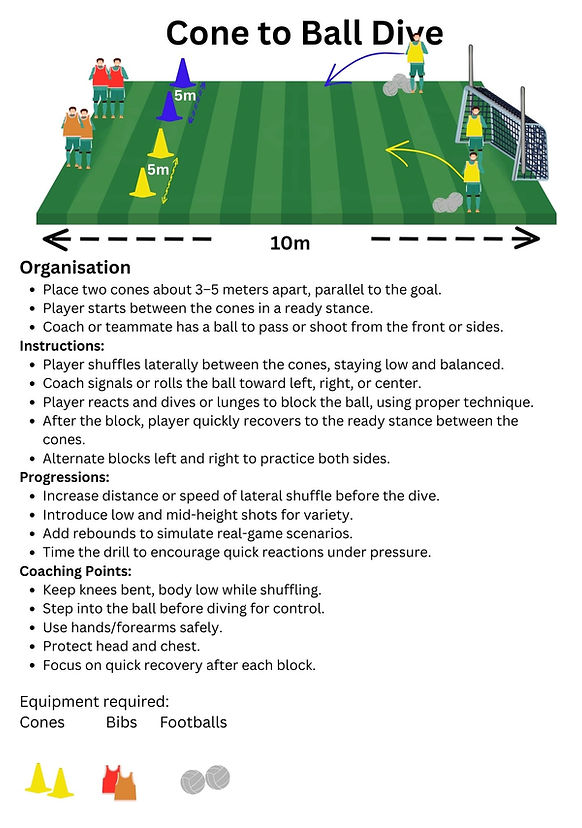
DIVING BLOCK
Key Points:
-
Keep eyes on the ball.
-
Stay low with knees bent for quick reaction.
-
Step into position before diving.
-
Dive or lunge only when needed.
-
Use hands/forearms to block safely.
-
Protect your head and chest.
-
Recover quickly after the block.
-
Practice dives both left and right.



Videos of Additional
Diving Block Activities
Credit:Kiklix
Credit: Learning GAA
🏐 13–15 GAA Football – Diving Block Checklist
✅ Technique & Rules
-
Keep eyes on the ball at all times.
-
Bend knees slightly and stay low to react quickly.
-
Step toward the ball with the lead foot to adjust position.
-
Dive or lunge only when necessary to intercept or block a shot.
-
Use hands and forearms to stop the ball, keeping elbows slightly bent.
-
Protect yourself by tucking your head and keeping chest forward.
-
Return to a ready stance immediately after the block.
✅ Skill Indicators
-
Intercepts or blocks the ball cleanly.
-
Maintains balance and control after diving.
-
Reacts quickly to different ball trajectories.
-
Can execute blocks on both sides (left and right) effectively.
✅ If the Player Struggles
-
Start with slow-moving balls to build confidence.
-
Practice dive technique onto soft mats before doing it on grass.
-
Break the skill into steps: positioning → lunge → block → recover.
-
Gradually increase speed, angle, and distance of incoming balls.
-
Encourage both-side diving to develop bilateral reaction skills.
Credit: Spark GAA
Tip: At 13–15 years, players are still growing, so gradual strength training (core, legs, and hips) and proper technique are more important than just trying to kick as hard as possible.
13-15 years Football
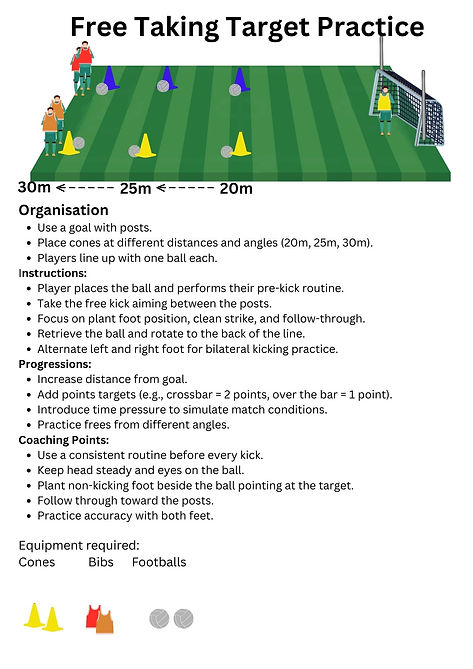
FREE TAKING
Key Points:
-
Use a consistent routine before each kick.
-
Keep eyes on the ball and target.
-
Plant non-kicking foot beside the ball pointing at the posts.
-
Strike the ball cleanly with the laces or inside of the foot.
-
Follow through toward the target.
-
Maintain good balance and body control.
-
Focus on accuracy before power.
-
Practice bilateral kicking (both left and right foot).


Videos of Additional
Free Taking Activities
Credit:Seanie O Shea
Credit: Learning GAA
🏐 13–15 GAA Football –
Free Taking Checklist
✅ Technique & Rules
-
Place the ball correctly on the ground or tee.
-
Take a consistent number of steps back before the kick.
-
Keep eyes on the target before striking.
-
Plant non-kicking foot beside the ball, pointing at the target.
-
Strike the ball with the laces for distance or inside of the foot for accuracy.
-
Follow through toward the posts after the kick.
-
Practice bilateral kicking (both left and right foot).
✅ Skill Indicators
-
Ball travels accurately between the posts.
-
Shows consistent routine before each kick.
-
Maintains balance and control during the strike.
-
Demonstrates good distance and accuracy.
-
Comfortable kicking with either foot.
✅ If the Player Struggles
-
Start with shorter distance frees.
-
Focus on plant foot position and body alignment.
-
Practice the same routine each time.
-
Increase distance gradually as accuracy improves.
-
Practice equal repetitions with both feet to develop bilateral kicking.
Credit:Dublin GAA
Tip: At 13–15 years, players are still growing, so gradual strength training (core, legs, and hips) and proper technique are more important than just trying to kick as hard as possible.
13-15 years Football
GAME BASED TRAINING
-
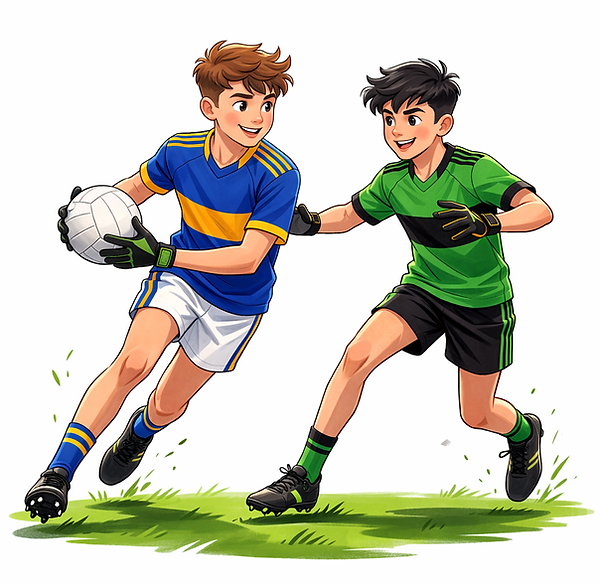
Game-based training means practicing skills through small-sided games and match-like situations rather than only isolated drills. This approach is very effective for young players.
-
For 13–15-year-old players, game-based training helps bridge the gap between drills and real matches, developing skills, decision-making, teamwork, and enjoyment of the game.
Videos of Additional
Free Taking Activities
Credit:Monaghan GAA
Credit: Learning GAA
🏐 13–15 GAA Football –
Game-Based Training Checklist
✅ Technique & Rules
-
Use small-sided games to practice skills.
-
Encourage passing, catching, and shooting in game situations.
-
Promote movement into space to support teammates.
-
Encourage decision-making (pass, solo, or shoot).
-
Allow players to use both feet for kicking and passing (bilateral skills).
-
Keep games competitive but fun.
✅ Skill Indicators
-
Players make quick decisions during play.
-
Demonstrates accurate passing and shooting under pressure.
-
Shows good teamwork and communication.
-
Moves into space to support teammates.
-
Uses both left and right foot during the game.
✅ If the Player Struggles
-
Use smaller teams (3v3 or 4v4) to increase involvement.
-
Reduce pitch size to help decision-making.
-
Add simple rules (e.g., 3 passes before scoring).
-
Encourage equal use of both feet.
-
Provide coaching feedback during breaks.
Credit:Alan Mullins
Tip: At 13–15 years, players are still growing, so gradual strength training (core, legs, and hips) and proper technique are more important than just trying to kick as hard as possible.
✅ Key Benefits
-
Improves Decision Making
Players learn when to pass, shoot, or carry the ball in real match situations. -
Develops Game Awareness
Helps players understand space, movement, and positioning during play. -
Applies Skills Under Pressure
Skills like kicking, catching, and tackling are practiced while being challenged by opponents. -
Increases Player Engagement
Game-based activities are more fun and motivating for teenagers. -
Encourages Teamwork & Communication
Players learn to support teammates and work as a unit. -
Improves Fitness Naturally
Running, changing direction, and reacting in games develop match-specific fitness. -
Builds Confidence
Players gain confidence by using their skills successfully in game situations. -
Supports Bilateral Skill Development
Players naturally practice kicking and passing with both feet during games.
🏐 Game-Based Training Techniques (13–15 GAA Football)
-
Small-Sided Games – Use games like 3v3, 4v4, or 5v5 to increase touches and involvement.
-
Conditioned Games – Add simple rules such as 3 passes before scoring or weaker foot scores worth double.
-
Directional Games – Play with goals or target zones so players must attack and defend realistically.
-
Overload / Underload Games – Create situations like 4 attackers vs 3 defenders to develop decision-making.
-
Transition Games – Focus on quick switching from attack to defence after possession changes.
-
Target Player Games – Use a neutral or target player to encourage movement and support play.
-
Time-Limited Games – Short 30–60 second rounds to increase intensity and decision-making speed.
-
Zone Games – Divide the pitch into zones to encourage spreading out, movement, and positional awareness.
-
Keep-Ball Games – Teams try to maintain possession with quick passing and movement.
-
End-Zone Games – Instead of posts, players score by carrying or passing into an end zone, encouraging support runs.
-
Numbers Game – Coach calls a number (e.g., 3v3 or 4v4) and players quickly enter the pitch to play.
-
Wave Games – One team attacks, then the next group immediately counterattacks after a shot or turnover.
-
Turnover Games – When possession changes, teams must quickly switch from defence to attack.


Key Focus Areas
-
Skill application in match-like situations
-
Quick, accurate decision-making
-
Awareness of space and teammates
-
Team communication and support
-
Balanced use of both feet
