
_edited.png)
8-12 years Football
The 8–12 age group is a key stage in a young player’s development in Gaelic football. At this age, the focus is on fun, participation, and skill development in a positive and supportive environment.
Players are in an important learning phase where they are highly receptive to developing fundamental movement skills such as agility, balance, coordination, and speed, alongside core football skills like kicking, catching, hand passing, soloing, and tackling.
8-12 years Football
Coach Season Planner
Sample

Coach Season Planner
Printable Template


TAP TO
OPEN

Coach Session Planner
Sample

Coach Season Planner
Printable Template


TAP TO
OPEN
© 2026 The Duhallow Juvenile Clubs GAA Coaching Website & App. All rights reserved.
© 2026 The Duhallow Juvenile Clubs GAA Coaching Website & App. All rights reserved.
Go Games
Calendar 2026

Football
Skills Assessment
8-12 years
-
In line with GDPR guidelines, no player names are recorded during skills activities.
-
Children are referred to by numbers or codes only, and any observations are for coach/teacher use only.
-
GAA skills assessment for ages 8–12 focuses on developing and improving fundamental Gaelic football and hurling skills.
-
Activities are age-appropriate, structured, and still enjoyable.
-
Key skills assessed include kicking, hand passing, catching, striking, and soloing.
-
Testing helps children understand correct technique in both football and hurling.
-
It allows coaches and teachers to track skill development and progress.
-
Emphasis is placed on participation, improvement, and confidence building.
-
Skills Assessment helps the coach prepare players for more competitive games at older age levels.


TAP TO
OPEN

For Coach Use Only


Coaching Tip: For 8–12 year olds, skill assessment can still be integrated into game-based activities. Rather than running formal “tests,” use conditioned games, small-sided matches, and skill challenges to observe technique, decision-making, and consistency in a natural playing environment..

-
Coaching Tip: Be clear and constructive with feedback. At this age, players can understand simple performance goals. Share individual focus points (e.g., first touch, weaker foot use, striking technique) and encourage self-reflection — helping them take ownership of their development while keeping confidence high.

GAA Football Rules for Ages 8–12 (Go Games)

At ages 8–12, Gaelic Football is played under the GAA’s “Go Games” model, which is designed to give every child the opportunity to play, learn and enjoy the sport in a safe, development-focused environment. Go Games emphasises fun, skill development and participation over competition — every player gets to play the full game, and scores and results are not officially recorded in younger age groups. This approach uses appropriately sized teams, modified rules and small-sided games to help players build confidence, improve their skills and foster a lifelong love of Gaelic Football.


GAA Football Rules for Ages 8–12
(Go Games)
🟢 1. Development-centred Focus
-
At ages 8–12, Gaelic Football is played under the Go Games model, which prioritises participation, skill development, fun, and inclusion over competition. Every child should play in every game and get meaningful playing time.
2. Small-sided Games
Game size increases gradually with age:
-
Under-8 & Under-9: smaller games (e.g., ~5v5 to ~6v6)
-
Under-10 to Under-11: medium small-sided games (e.g., ~6v6 to ~8v8)
-
Under-12: larger (e.g., ~11v11), but still development-focused rather than highly competitive
The exact numbers can vary by club or county but follow Go Games recommendations.


🟢 3. No Competitive Elements
Games under 12 years old:
-
Do not have official competitive scores recorded (no official league standings).
-
No titles, knock-outs, finals, or trophies — all players are recognised equally.
-
Certificates can be presented, but the same award for every participant.
This keeps the focus on learning and enjoyment.
4. Equal Playing Time
All children are encouraged to:
-
Get equal game time
-
Rotate positions so they experience different skills and roles
-
Play in supportive, non-intimidating settings
This is core to Go Games philosophy.
🔴
🔴
🟢
🔴 5. Skill-Appropriate Rules
As players get older within the 8–12 range:
-
The standard Gaelic Football rules apply (e.g. catching, soloing, kick passing)
-
Younger players may have modified rules that reduce complexity or physical demands
-
The emphasis is on basic skills, decision-making, teamwork, and fun
Precise adaptations depend on local coaching but always stay within Go Games best practice.
6. Team Size & Pitch
Recommended formats by age (general guide):
-
U8 & U9: small sided (e.g., up to 9 per side)
-
U10 & U11: medium (e.g., ~6–11 per side)
-
U12: larger small sided (~11 per side)
Pitch size and goals should be adapted for age and ability to keep the game flowing.
7. Participation Flexibility
Players may:
-
Play up one age grade if appropriate
-
Clubs should encourage mixed participation where numbers are low
This helps ensure every child gets time on the pitch.
8. Go Games Principles
Throughout ages U8–12, the Go Games approach:
-
Makes sure every child plays and enjoys football
-
Builds skills on both sides of the body
-
Encourages fair play, respect, and inclusion
-
Is designed for skill development over results
🔴
🟢
8-12 years Football
PUNT KICK
🏐 Key Points
-
Hold the ball in both hands
-
Drop the ball onto the foot (don’t throw)
-
Point the toe down
-
Kick with the laces
-
Step forward with opposite foot
-
Follow through towards the target.
🗣 Simple cue: “Drop – Toe down – Laces – Follow through!”


Videos of Additional
Kicking Activities
Credit: Learning GAA
Credit: Learning GAA
Credit: Tramore GAA
Credit:Connacht GAA
Credit: Learning GAA
🏐 Punt Kick Checklist
✅ Technique & Rules
-
Keep eyes on the ball.
-
Hold the ball vertically in the hand.
-
Drop the ball straight onto the kicking foot.
-
Strike with the laces (instep).
-
Point the toe down and lock the ankle.
-
Follow through towards the target.
-
Keep balance on the non-kicking foot.
✅ Skill Indicators
-
Can punt kick with consistent height and distance.
-
Can kick accurately to a teammate or target.
-
Uses both left and right foot when encouraged.
-
Maintains balance after the kick.
-
Begins to punt kick on the move.
✅ If the Player Struggles with Punt Kick
-
Practice drop → kick without focusing on distance.
-
Start with short punts, then build up gradually.
-
Use target cones to improve accuracy.
-
Slow the drop if timing is inconsistent.


8-12 years Football
HOOK KICK
🏐 Key Points
-
Drop the ball to the kicking foot side.
-
Strike with the inside of the foot.
-
Eyes on the ball.
-
Follow through toward the target.


Videos of Additional
Kicking Activities
Credit GAA.ie
Credit Tramore GAA
Credit LGFA
Credit:Connacht GAA
Credit: Learning GAA
🏐 Hook Kick Checklist
✅ Technique & Rules
-
Hold the ball in both hands.
-
Drop the ball onto the kicking foot side.
-
Strike the bottom half of the ball with the inside of the foot.
-
Follow through toward the target.
✅ Skill Indicators
-
Makes clean contact with the ball.
-
Ball travels low and accurate.
-
Maintains balance after the kick.
-
Can kick off both left and right foot.
✅ If the Player Struggles
-
Practice the drop without kicking first.
-
Start with short distances.
-
Focus on foot placement and follow-through.
-
Build confidence before increasing distance.
8-12 years Football
SOLO
🏐 Key Points
-
Kick ball into hands while running.
-
Lift ball onto instep → catch with hands → solo every 2–3 steps.
-
Wall solo, cone solo, solo & turn.
-
Tips: Keep eyes on ball, relax, use both feet, start slow.


Videos of Additional
Solo Activities
Credit: Learning GAA
Credit:Connacht GAA
Credit:LGFA
Credit: Learning GAA
Credit: Learning GAA
🏐 Solo Checklist
✅ Technique & Rules
-
Keep eyes on the ball during the drop.
-
Hold the ball securely in one hand.
-
Drop the ball straight onto the foot.
-
Strike with the laces (instep).
-
Catch the ball cleanly at chest height.
-
Take controlled steps between solos.
-
Solo after 4 steps or less.
✅ Skill Indicators
-
Can solo smoothly while moving at speed.
-
Can solo using both left and right foot.
-
Maintains balance and control when turning.
-
Looks up to assess options while soloing.
-
Can solo under light pressure.
✅ If the Player Struggles to Solo
-
Break the skill into drop → kick → catch.
-
Practice stationary solo before adding movement.
-
Use target cones to guide steps and timing.
-
Slow the movement until control improves.
8-12 years Football
FIRST TOUCH
-
Control the ball immediately after receiving it
-
Feet for ground balls, hands for air balls, chest/thigh for high balls.
-
Keep eyes on the ball, relax, direct away from pressure.
-
Wall pass, partner passing, solo movement.
🏐 Key Points


Videos of Additional
First Touch Activities
Credit: Colm Nally:
Credit: Colm Nally:
Credit:Our Game
Credit:Connacht GAA
Credit: Learning GAA
🏐 First Touch
Checklist
✅ Technique & Rules
-
Keep eyes on the ball as it arrives.
-
Get hands ready early in front of the body.
-
Move towards the ball to meet it.
-
Cushion the ball into the hands or chest.
-
Secure the ball before moving on.
✅ Skill Indicators
-
Controls the ball cleanly on first contact.
-
Can receive passes at different heights and speeds.
-
Takes first touch into space.
-
Maintains balance after receiving the ball.
-
Looks up quickly after the first touch.
✅ If the Player Struggles with First Touch
-
Use short, gentle passes to build confidence.
-
Practice ready hands and movement without pressure.
-
Progress from stationary to moving receptions.
-
Use lighter balls if needed, then return to match ball.
8-12 years Football
HAND PASSING
🏐 Key Points
-
Passing the ball using your hand to strike it to a teammate.
-
Hold ball in non-dominant hand.
-
Strike with a closed fist or flat hand from opposite hand.
-
Step into the pass and follow through.
-
Keep it accurate, chest-height, and quick.
-
Partner passing, moving hand-pass drills, pressure passing.

________

Hand Pass


Videos of Additional
Hand Passing Activities
Credit: Learning GAA
Credit:Tramore GAA
Credit:Tramore GAA
Credit: Connacht GAA
Credit: Learning GAA
🏐 Handpass Checklist
✅ Technique & Rules
-
Hold the ball securely in one hand.
-
Make a clear striking action with the other hand.
-
Strike the ball with the flat of the hand.
-
Follow through towards the target.
-
Step forward to add power and accuracy.
-
Handpass must be a clear strike (not a throw).
✅ Skill Indicators
-
Can handpass accurately over short and medium distances.
-
Uses both left and right hand when encouraged.
-
Can handpass while moving.
-
Selects the correct handpass option in games.
-
Maintains balance after the pass.
✅ If the Player Struggles with Handpass
-
Practice stationary handpass first.
-
Focus on strike action (no pushing).
-
Use targets to improve accuracy.
-
Reduce distance, then build gradually.
8-12 years Football
BLOCKING
🏐 Key Points
-
Blocking; : Stopping a kick or handpass.
-
Close down quickly, stay low, extend arm/leg at last moment.
-
Time it right—don’t swing wildly.


Videos of Additional
Blocking Activities
Credit:Tramore GAA
Credit:Clanna Gael Fontenoy
Credit: Connacht GAA
Credit: Learning GAA
🏐 Blocking Checklist
✅ Technique & Rules
-
Keep eyes on the ball, not the player.
-
Stay side-on with knees bent and body low.
-
Time the block as the player kicks or handpasses.
-
Use one arm to block, the other for balance.
✅ Skill Indicators
-
Can block kick or handpass effectively.
-
Maintains balance after contact.
-
Recovers quickly to contest the ball.
-
Shows confidence and correct decision-making.
✅ If the Player Struggles with Blocking
-
Practice shadow defending (no contact).
-
Work on timing and footwork first.
-
Introduce controlled contact gradually.
-
Reinforce rules to build confidence and safety.
TACKLING
8-12 years Football
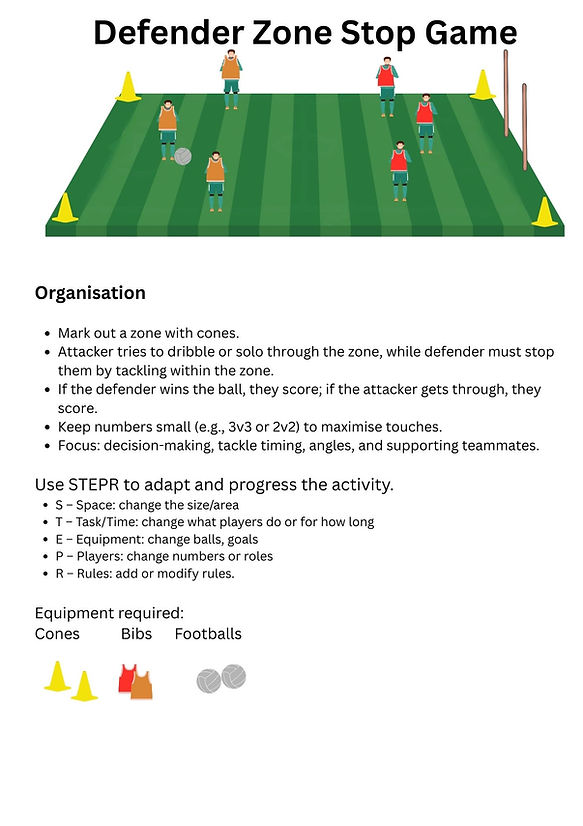
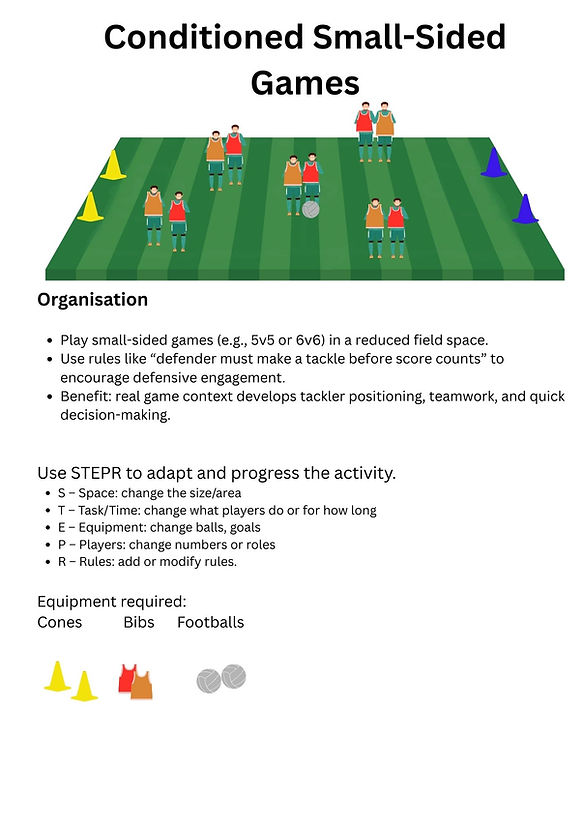
🏐 Key Points
Tackling; Dispossessing or delaying an opponent.
-
How: Stay side-on, keep feet moving, use shoulder-to-shoulder contact.
-
Tip: Watch the ball, not the player.


Videos of Additional
Tackling Activities
Credit:Bray Emmets Coaching
Credit: CLG na Fianna
Credit: Learning GAA
Credit: Connacht GAA
Credit: Learning GAA
🏐Tackling Checklist
✅ Technique & Rules
-
Stay on your feet and keep balanced.
-
Approach the opponent from the side or front.
-
Use a near-hand tackle to get the ball (not pulling or pushing).
-
Keep eyes on the ball and follow through toward the ball.
✅ Skill Indicators
-
Makes legal contact with the ball, not the player.
-
Times the tackle when the opponent has to play the ball (solo/bounce).
-
Maintains balance and control after contact.
-
Can slow or stop the opponent safely.
✅ If the Player Struggles
-
Practice tackling movements without the ball first.
-
Use slow, controlled situations to build confidence.
-
Walk through near-hand technique step by step.
-
Gradually add realistic movement and game-like speed
8-12 years Football
HIGH CATCH
🏐 Key Points
-
Catching the ball above head height.
-
Time your jump, extend arms fully, catch at highest point.
-
“W” shape behind the ball, fingers spread.
-
Keep eyes on ball, knee up for protection, land balanced.


Videos of Additional
High Catch Activities
Credit:Connacht GAA
Credit: Learning GAA
Credit: CLG na Fianna
Credit: Connacht GAA
Credit: Learning GAA
🏐 High Catch Checklist
✅ Technique & Rules
-
Keep eyes on the ball from early flight.
-
Judge the flight and move into position.
-
Jump off one foot, raising the opposite knee.
-
Catch the ball at the highest point.
-
Use the “W” hand shape behind the ball.
-
Secure the ball and land balanced.
✅ Skill Indicators
-
Can catch cleanly under little or no pressure.
-
Times jump effectively for high balls.
-
Maintains balance on landing.
-
Can catch while being lightly challenged.
-
Shows confidence attacking the ball.
✅ If the Player Struggles with High Catch
-
Practice overhead throw and catch first.
-
Break down into jump → catch → land.
-
Use soft balls to build confidence.
-
Introduce pressure gradually.
8-12 years Movement Skills
ABC AGILITY - BALANCE- COORDINATION
RJT RUNNING- JUMPING - THROWING


OBSTACLE COURSE


CHASING GAMES


Videos of Additional
Movement Activities
Credit:Leinster GAA
Credit:360 Player
Credit:Fitspiration
Credit:GazGaelic Guide
Credit Connacht GAA
Credit: Learning GAA
8–12 Years Hurling –
Blocking Checklist
✅ Technique & Rules
-
Stay low with knees bent
-
Present the bas of the hurley
-
Keep head up and eyes forward
-
Absorb contact and recover quickly
✅ Skill Indicators
-
Stops or deflects the sliotar
-
Maintains balance on contact
-
Recovers quickly to play on
-
Shows confidence when blocking
✅ If the Player Struggles
-
Start with slow, controlled strikes
-
Practice block position without a sliotar
-
Reduce distance and speed
-
Reinforce correct technique and bravery
MULTI DIRECTIONAL RUNNING WITH HURL/ BALL
