
_edited.png)
8-12 years Hurling
The 8–12 age group is a vital stage in a young player’s development in Hurling. At this age, the emphasis is on enjoyment, inclusion, and building confidence within a fun, safe, and encouraging environment. Players are in a key learning phase where they are especially open to developing fundamental movement skills such as agility, balance, coordination, and speed, while also refining essential hurling techniques including striking, catching, lifting, blocking, hand passing, and developing control of the sliotar. The overall aim is to nurture a lifelong love of the game while laying strong technical and physical foundations for future progress.
8-12 years Hurling
Coach Season Planner
Sample

Coach Season Planner
Printable Template


TAP TO
OPEN

Coach Session Planner
Sample

Coach Season Planner
Printable Template


TAP TO
OPEN
© 2026 The Duhallow Juvenile Clubs GAA Coaching Website & App. All rights reserved.
© 2026 The Duhallow Juvenile Clubs GAA Coaching Website & App. All rights reserved.
Go Games
Calendar 2026

GAA Hurling Rules for Ages 8–12 (Go Games)
At ages 8–12, hurling is played under the GAA’s Go Games model, which focuses on participation, skill development, and enjoyment rather than winning. As children grow in confidence and ability, the rules gradually become more structured, introducing skills such as lifting, striking from the hand, soloing, and controlled shoulder contact in a safe and supportive environment. Team sizes and pitch dimensions are adapted to suit the players’ age and stage of development, ensuring every child gets meaningful game time while continuing to build their skills and love for hurling.
GAA Hurling Rules for Ages 8–12
(Go Games)
🟢 1. Game Format
-
Games follow the GAA Go Games model: designed to help kids learn skills, have fun, and play as much as possible.
-
Team sizes increase with age — smaller numbers keep children involved and active.
-
Younger players: smaller teams (e.g., 6v6 / 8v8)
-
Older ages (U12): larger small-sided games (e.g., up to ~11v11 depending on numbers)
-
2. Playing Time
-
Every child plays in every game from start to finish, with equal playing time encouraged for all players.
-
Shorter halves or quarters help keep children focused and energetic.
🟢 3. Equipment & Safety
-
All players must wear a helmet with a faceguard — safety is essential in hurling.
-
Use a child-appropriate hurley that fits to the player’s height and skill level.
-
Sliotars should be age-appropriate (First Touch / soft versions in younger age groups).
4. Contact & Physical Play
-
Games are played in a safe, supportive environment focusing on skill, not strength.
-
Younger players focus on ground hurling, catching, and striking from the ground.
-
As ages progress toward 12, lifting the sliotar, striking from the hand, and controlled shoulder-to-shoulder contact are introduced gradually — always with coaching emphasis on correct technique and safety.
-
5. Playing the Ball
-
Encourage ball skills including:
-
Ground striking
-
Lifting the sliotar safely
-
Hand catching
-
Striking from the hand (progressively)
-
The focus is on building confidence and control rather than strict enforcement of full adult rules.
🔴
🔴


🟢
6. Scoring
-
Simple scoring rules apply (goals and points as usual), unless locally agreed otherwise to keep games fun and pressure-free.
-
Many clubs avoid keeping official scores at U8–U11 level so that children aren’t pressured by results.
7. Restarts
-
Sideline pucks and puck-outs follow modified rules so that play restarts quickly and kids keep involved — coaches and referees often guide these in a developmental way.
🔴
8. Rotation & Participation
-
Coaches should rotate players through positions so children experience different parts of the game.
-
Substitutions are unlimited and rolling, ensuring no child is sidelined for long.
9. Environment & Culture
-
Play is structured to maximise fun, fair play, friendship, and achievement.
-
Scores, tables, finals, and trophies are not emphasised at U11 and below — the goal is learning and involvement.
10. Coaching Focus
-
Keep instructions positive, simple, and encouraging.
-
Emphasise basic skills first — catching, striking, and decision-making.
-
Allow children to make mistakes and learn through play.
🔴
🔴
🟢
🟢


Summary
For ages 8–12, hurling under the Go Games approach means:
-
Smaller teams based on age
-
Fun, skill-centred games
-
Safety first with helmets and appropriate hurleys
-
Equal playing opportunity for every child
-
Minimal emphasis on competition or results


Hurling
Skills Assessment
8-12 years
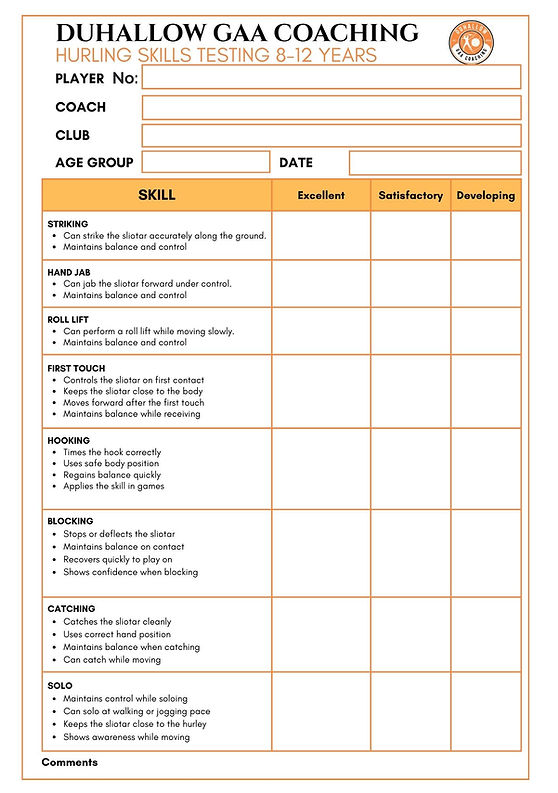
-
In line with GDPR guidelines, no player names are recorded during skills activities.
-
Children are referred to by numbers or codes only, and any observations are for coach/teacher use only.
-
GAA skills assessment for ages 8–12 focuses on developing and improving fundamental Gaelic football and hurling skills.
-
Activities are age-appropriate, structured, and still enjoyable.
-
Key skills assessed include kicking, hand passing, catching, striking, and soloing.
-
Testing helps children understand correct technique in both football and hurling.
-
It allows coaches and teachers to track skill development and progress.
-
Emphasis is placed on participation, improvement, and confidence building.
-
Skills Assessment helps the coach prepare players for more competitive games at older age levels.


TAP TO
OPEN

For Coach Use Only


Coaching Tip: For 8–12 year olds, skill assessment can still be integrated into game-based activities. Rather than running formal “tests,” use conditioned games, small-sided matches, and skill challenges to observe technique, decision-making, and consistency in a natural playing environment..

-
Coaching Tip: Be clear and constructive with feedback. At this age, players can understand simple performance goals. Share individual focus points (e.g., first touch, weaker foot use, striking technique) and encourage self-reflection — helping them take ownership of their development while keeping confidence high.

8-12 years Hurling
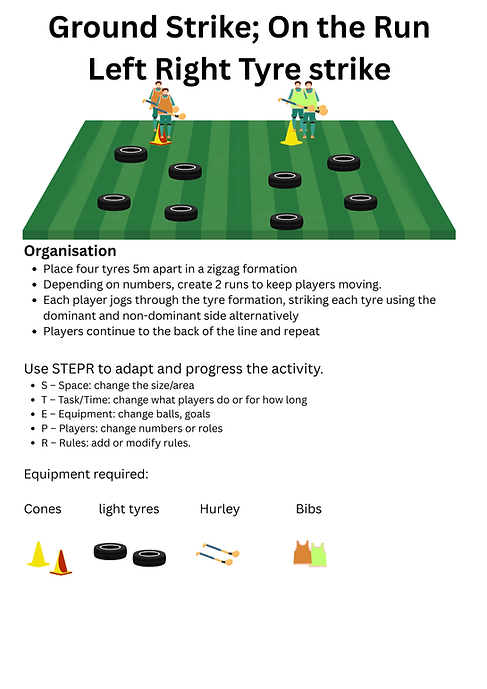
GROUND STRIKING

Key Points
-
Place the hurley behind the sliotar
-
Keep eyes on the sliotar
-
Use a short swing
-
Strike the sliotar along the ground



Videos of Additional
Ground Striking
Credit: Learning GAA
Credit: Learning GAA
Credit:Connacht GAA
Credit: Learning GAA
8–12 Years Hurling –
Ground Striking Checklist
✅ Technique & Rules
Ground Strike
-
Keep eyes on the sliotar.
-
Place the hurley behind the sliotar.
-
Use a short, controlled swing.
-
Strike the sliotar along the ground toward the target.
✅ Skill Indicators
-
Can strike the sliotar accurately along the ground.
-
Maintains balance and control during strike action.
✅ If the Player Struggles
-
Practice each skill while stationary first.
-
Slow the movement down and focus on technique.
-
Break skills into steps and build them back together.
-
Use repetition and encouragement to build confidence.

8-12 years Hurling
JAB LIFT
Key Points
-
Hold the hurl with a strong bottom hand grip.
-
Turn the bas (toe) of the hurl slightly inward.
-
Slide the bas under the sliotar with a short, sharp jab.
-
Jab under the ball — don’t scoop or flick wildly.
-
Use a quick wrist action.
-
Lift the sliotar smoothly into the hand.
-
Keep control — the ball should come up in front of you.


Videos of Additional
Jab Lift Activities
Credit: Learning GAA
Credit: Learning GAA
Credit: Connacht GAA
8–12 Years Hurling –
Jab lift Checklist
✅ Technique & Rules
Jab Lift Hold the hurley with a strong grip.
-
Keep the hurley low to the ground.
-
Jab the sliotar forward, not upwards
-
Follow through in the direction of the target.
✅ Skill Indicators
-
Can jab the sliotar forward under control.
-
Maintains balance and control during the skill.
✅ If the Player Struggles
-
Practice each skill while stationary first.
-
Slow the movement down and focus on technique.
-
Break skills into steps and build them back together.
-
Use repetition and encouragement to build confidence.
Credit: Learning GAA
8-12 years Hurling
ROLL LIFT
Key Points
-
Hold the hurl with two hands for control.
-
Place the bas (toe) of the hurl behind the sliotar.
-
Keep the hurl low to the ground.
-
Gently roll the sliotar up the bas of the hurl.
-
Use a smooth lifting motion — not a flick.
-
Guide the ball into your hand at about waist height.
-
Stay balanced throughout.


Videos of Additional
Roll Lift Activities
Credit: Learning GAA
Credit: Learning GAA
Credit:Connacht GAA
Credit: Learning GAA
8–12 Years Hurling –
Roll Lift Checklist
✅ Technique & Rules
Roll Lift
-
Place the hurley flat on the ground.
-
Roll the sliotar onto the bas of the hurley.
-
Bend knees to stay balanced.
-
Lift smoothly into the hand.
✅ Skill Indicators
-
Can perform a roll lift while moving slowly.
-
Maintains balance and control during each skill.
✅ If the Player Struggles
-
Practice each skill while stationary first.
-
Slow the movement down and focus on technique.
-
Break skills into steps and build them back together.
-
Use repetition and encouragement to build confidence.
8-12 years Hurling
FIRST TOUCH
Key Points
-
First Touch
-
Keep eyes on the sliotar
-
Soft hands and relaxed grip
-
Cushion the sliotar into control
-
Move into space after the first touch


Videos of Additional
First Touch Activities
8–12 Years Hurling –
First Touch Checklist
✅ Technique & Rules
-
Keep eyes on the sliotar
-
Relax the grip and use soft hands
-
Cushion the sliotar into control
-
Move into space after the first touch
✅ Skill Indicators
-
Controls the sliotar on first contact
-
Keeps the sliotar close to the body
-
Moves forward after the first touch
-
Maintains balance while receiving
✅ If the Player Struggles
-
Practice stationary controls first
-
Use short, gentle feeds
-
Slow the drill down
-
Build confidence before adding pressure
Credit: Dublin GAA Coach
Credit:Dublin GAA Coach
Credit: Hurling Drills
Credit:Wexford GAA
Credit: Connacht GAA
Credit: Learning GAA
8-12 years Hurling
HOOKING
Key Points
-
Approach from the side or slightly behind
-
Keep eyes on the hurley, not the sliotar
-
Hook the opponent’s hurley, not their arms
-
Maintain balance and correct body position


Videos of Additional
Hooking Activities
Credit: Naoise Hurling
Credit: Monharps hurling clg
Credit: All Saints GAA
Credit:Connacht GAA
8–12 Years Hurling –
Hooking Checklist
✅ Technique & Rules
-
Approach from the side or slightly behind
-
Focus on the opponent’s hurley
-
Hook the hurley, not the arms
-
Maintain balance and control
✅ Skill Indicators
-
Times the hook correctly
-
Uses safe body position
-
Regains balance quickly
-
Applies the skill in games
✅ If the Player Struggles
-
Practice the movement without a sliotar
-
Walk through the skill slowly
-
Use a cooperative partner
-
Gradually increase pace

Credit: Learning GAA

8-12 years Hurling
BLOCKING
Key Points
-
Stay low with knees bent
-
Present the bas of the hurley to the ball
-
Keep head and eyes up
-
Recover quickly after the block


Videos of Additional
Blocking Activities
Credit: Naoise Hurling
Credit: Naoise Hurling
Credit: Learning GAA
Credit: Learning GAA

8–12 Years Hurling –
Blocking Checklist
✅ Technique & Rules
-
Stay low with knees bent
-
Present the bas of the hurley
-
Keep head up and eyes forward
-
Absorb contact and recover quickly
✅ Skill Indicators
-
Stops or deflects the sliotar
-
Maintains balance on contact
-
Recovers quickly to play on
-
Shows confidence when blocking
✅ If the Player Struggles
-
Start with slow, controlled strikes
-
Practice block position without a sliotar
-
Reduce distance and speed
-
Reinforce correct technique and bravery
Credit: Connacht GAA
Credit: Learning GAA
8-12 years Hurling
CATCHING
Key Points
-
Keep eyes on the sliotar
-
Move feet to get in line with the ball
-
Reach out and catch at the highest point
-
Cushion the sliotar into the hand


Videos of Additional
Catching Activities
Credit: All Saints GAA
Credit:The Ultimate Explainer
Credit: Learning GAA
Credit:Connacht GAA
Credit: Learning GAA
8–12 Years Hurling
Catching Checklist
✅ Technique & Rules
-
Keep eyes on the sliotar
-
Move feet to get in line with the ball
-
Catch at the highest point possible
-
Cushion the sliotar into the hand
✅ Skill Indicators
-
Catches the sliotar cleanly
-
Uses correct hand position
-
Maintains balance when catching
-
Can catch while moving
✅ If the Player Struggles
-
Practice stationary throws and catches
-
Use short, gentle feeds
-
Focus on hand position first
-
Gradually add movement

8-12 years Hurling
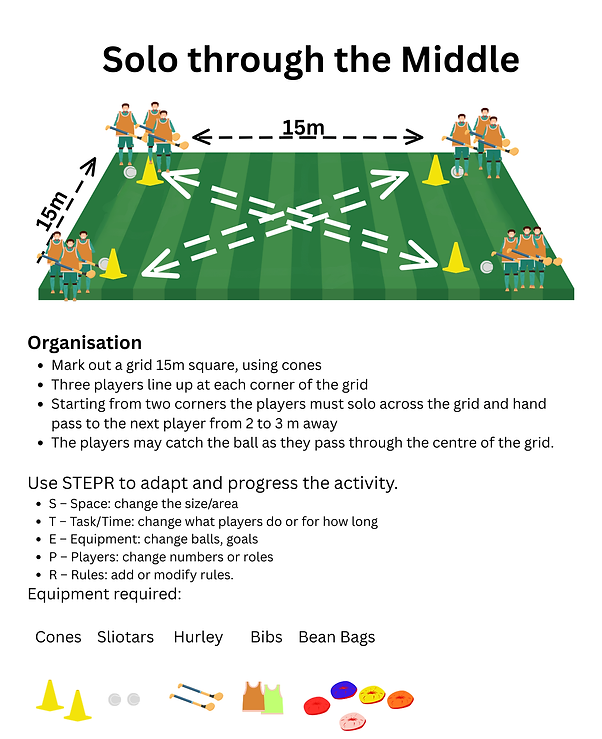
SOLOING
Key Points
-
Balance the sliotar on the bas of the hurley
-
Keep the hurley close to the body
-
Tap the sliotar gently and under control
-
Look up occasionally while soloing


Videos of Additional
Solo Activities
Credit:Eamonn GAA
Credit: Eamonn GAA
Credit: CLG na Fianna
Credit:Connacht GAA
8–12 Years Hurling
Solo Checklist
✅ Technique & Rules
-
Balance the sliotar on the bas of the hurley
-
Keep the hurley close to the body
-
Tap the sliotar gently and under control
-
Keep eyes on the sliotar, look up occasionally
✅ Skill Indicators
-
Maintains control while soloing
-
Can solo at walking or jogging pace
-
Keeps the sliotar close to the hurley
-
Shows awareness while moving
✅ If the Player Struggles
-
Practice balancing the sliotar while stationary
-
Use short solo taps first
-
Slow the movement down
-
Build confidence before increasing speed
Credit: Learning GAA
8-12 years Movement Skills
ABC AGILITY - BALANCE- COORDINATION
RJT RUNNING- JUMPING - THROWING
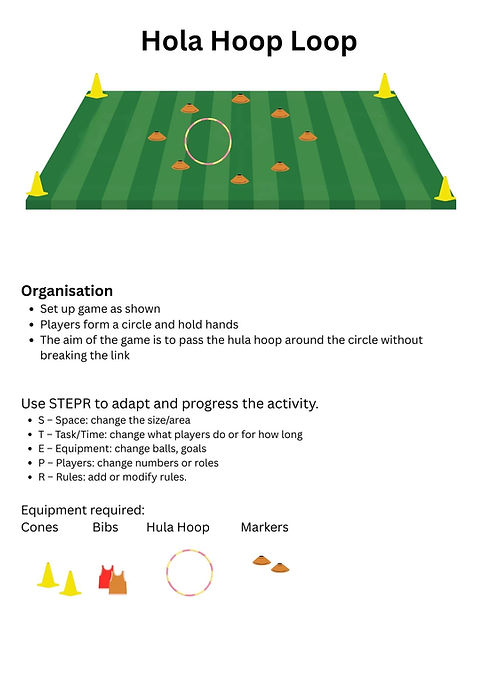
OBSTACLE COURSE


CHASING GAMES


Videos of Additional
Movement Activities
Credit:Leinster GAA
Credit:360 Player
Credit:Fitspiration
Credit:GazGaelic Guide
Credit Connacht GAA
Credit: Learning GAA
8–12 Years Hurling –
Blocking Checklist
✅ Technique & Rules
-
Stay low with knees bent
-
Present the bas of the hurley
-
Keep head up and eyes forward
-
Absorb contact and recover quickly
✅ Skill Indicators
-
Stops or deflects the sliotar
-
Maintains balance on contact
-
Recovers quickly to play on
-
Shows confidence when blocking
✅ If the Player Struggles
-
Start with slow, controlled strikes
-
Practice block position without a sliotar
-
Reduce distance and speed
-
Reinforce correct technique and bravery
MULTI DIRECTIONAL RUNNING WITH HURL/ BALL
