

_edited.png)
13-15 years Hurling
The 13-15 age group is for a young hurling player's growth. Focus shifts skill improvement, teamwork, and game strategies in a supportive environment. Players refine techniques like striking and defending while boosting fitness. The goal is to foster a love for hurling and build a strong foundation for future success.
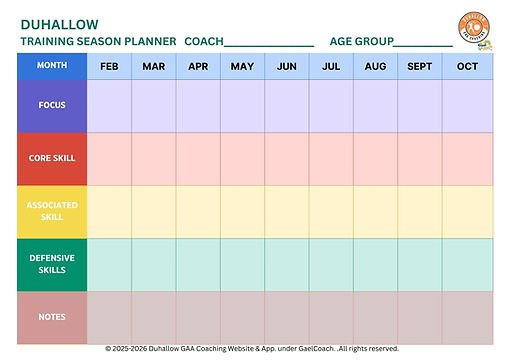
Coach Season Planner
Sample

Coach Season Planner
Printable Template

TAP TO
OPEN
Coach Session Planner
Sample

Coach Session Planner
Printable Template
TAP TO
OPEN
Hurling
Skills Assessment
13-15 years
-
In line with GDPR guidelines, player names are not recorded during skills activities for 13-15-year-olds; children are identified by numbers or codes for coach use only.
-
The skills assessment focuses on refining Gaelic football through enjoyable activities with increased emphasis on Game based Training.
-
Key skills like Passing from the Hurley, Passing to Moving target & Free-taking are assessed to ensure proper technique and track progress, emphasizing participation and confidence to prepare players for competitive games.


TAP TO
OPEN


Coaching Tip: For 13–15 year olds, assess skills through game-based activities instead of formal tests. Use small-sided matches and skill challenges to observe techniques, decision-making, and consistency in a natural setting. This keeps engaging while providing real-time feedback for player development.

-
Coaching Tip: Offer clear and constructive feedback. Players can understand basic goals, so focus on areas like first passing to moving target and striking technique. Encourage self-ref to help them own their development while maintaining confidence. A positive environment is essential for growth!


For Coach Use Only
GAA Hurling Rules for Ages 13-15 years

For players aged 13–15, the rules of hurling begin to closely follow the full game played at adult level in the Gaelic Athletic Association. At this stage, players develop more advanced skills such as striking from the hand, catching high balls, soloing the sliotar on the hurley, and working together as a team in set positions on the field. Games are played on larger pitches with full teams, helping players build fitness, confidence, and tactical awareness. While competition becomes more structured, the focus remains on skill development, fair play, and enjoyment as players continue learning and preparing for higher levels of hurling.
GAA Hurling Rules for Ages 13-15 years
1. Game Format
-
Games begin to follow the full rules of hurling, preparing players for minor and adult levels.
-
Teams usually play 15 vs 15 on a full-sized pitch, depending on the competition or club structure.
-
Matches are played within organised leagues and championships, introducing players to more structured competition.
2. Playing Time
-
Games are generally played in two halves, typically 20–25 minutes per half depending on the competition.
-
Substitutions are allowed, but coaches are encouraged to ensure all players receive meaningful playing time.
3. Equipment & Safety
-
Helmets with faceguards are mandatory for all players.
-
Players must use a properly sized hurley suited to their height and ability.
-
A standard sliotar is used at this age level.
-
Referees and coaches ensure the game is played safely and fairly.
4. Contact & Physical Play
-
Shoulder-to-shoulder contact is permitted when contesting the ball.
-
Players may use their hurley to hook or block an opponent’s strike when done safely.
-
Dangerous play such as high swinging, pulling across the body, or reckless tackles is penalised.
5. Playing the Ball
Players are expected to demonstrate a wide range of hurling skills:
-
Ground striking
-
Lifting the sliotar with the hurley
-
Striking from the hand
-
Catching high balls
-
Soloing the sliotar on the hurley
-
Accurate passing and shooting
Players can carry the sliotar for four steps before striking, passing, or soloing.
6. Scoring
-
A goal (ball into the net) = 3 points
-
A point (ball over the crossbar) = 1 point
Scores are officially recorded and contribute to league standings and competitions.
🔴
🔴
🟢
7. Restarts
-
Games begin with a throw-in by the referee at midfield.
-
Puck-outs restart play after a score or wide ball.
-
Free pucks are awarded for fouls or rule infringements.
8. Positions & Team Play
-
Teams play with structured positions, including defenders, midfielders, and forwards.
-
Players begin to learn team tactics, positioning, and game strategies.
9. Discipline & Fair Play
-
Referees enforce rules using free pucks, yellow cards, and red cards where necessary.
-
Players are expected to show respect, discipline, and good sportsmanship.
10. Development Focus
At this stage, players continue developing:
-
Advanced striking and ball control
-
Speed and fitness
-
Decision-making and tactical awareness
-
Teamwork and communication
Coaches focus on preparing players for minor and adult hurling while keeping the game enjoyable and competitive.
🔴
🟢
🟢
🟢
🔴
🟢
🟢


Summary
For ages 13–15, hurling becomes closer to the full adult game:
-
Full teams and full pitches
-
Official scoring and organised competitions
-
Advanced skill and tactical development
-
Continued focus on safety and fair play

13-15 years Hurling
HAND-PASS FROM STICK
Key Points:
-
Keep eyes on the sliotar.
-
Balance sliotar on the bas of the hurley.
-
Step toward the target.
-
Strike with an open hand.
-
Follow through toward teammate.
-
Maintain balance and control.
-
Practice on both left and right sides.


Videos of Additional
Hand-Pass from Stick Activities
Credit:Tramore GAA
Credit: Learning GAA
13–15yrs Hurling –
Hand-Pass from Stick Checklist
✅ Technique & Rules
-
Hold the hurley firmly with dominant hand on top.
-
Balance the sliotar on the bas (flat part) of the hurley.
-
Keep eyes on the sliotar throughout the skill.
-
Step toward the target with the opposite foot.
-
Use an open hand to strike the sliotar from the hurley.
-
Follow through toward the target after the pass.
-
Practice using both left and right side (bilateral skill development).
✅ Skill Indicators
-
Hand pass travels accurately to a teammate.
-
Maintains control of the sliotar before striking.
-
Demonstrates good balance and coordination.
-
Can perform the skill while moving.
-
Comfortable using both sides when passing.
✅ If the Player Struggles
-
Start stationary before progressing to movement.
-
Use a larger or softer sliotar for confidence.
-
Reduce passing distance to focus on technique.
-
Practice the hand strike action separately first.
-
Encourage equal practice on both sides.
Credit:Naoise Training

Tip: At 13–15 years, players are still growing, so gradual strength training (core, legs, and hips) and proper technique are more important than just trying to play as hard as possible.
13-15 years Hurling
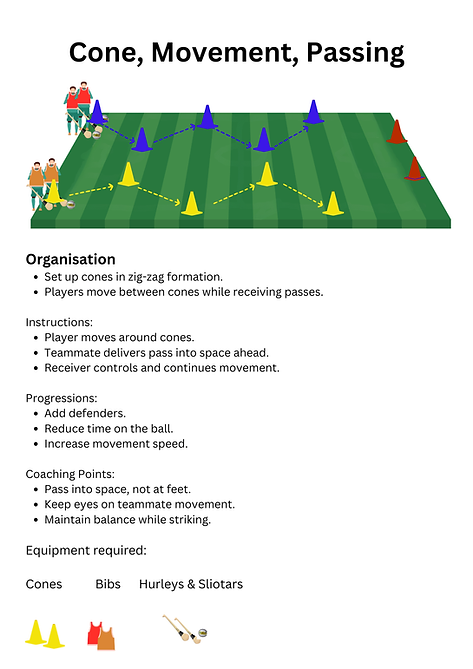
PASS TO MOVING TARGET
Key Points:
-
Keep head up before passing.
-
Lead the pass into space.
-
Step toward the target.
-
Strike smoothly and follow through.
-
Focus on timing and accuracy.
-
Maintain balance while moving.
-
Practice passing on both sides.


Videos of Additional
Pass to Moving Target Activities
Credit:Seanie O Shea
Credit: Learning GAA
13–15yrs Hurling –
Pass to Moving Target Checklist
✅ Technique & Rules
-
Keep head up to identify the moving teammate.
-
Grip the hurley correctly with relaxed hands.
-
Strike through the sliotar with controlled technique.
-
Lead the pass into the teammate’s path, not directly at them.
-
Step toward the target during the strike.
-
Follow through toward the direction of the pass.
-
Practice passing on both left and right sides (bilateral striking).
✅ Skill Indicators
-
Pass reaches teammate in stride.
-
Shows good timing and accuracy.
-
Maintains balance and control after passing.
-
Communicates effectively with teammates.
-
Comfortable passing on both sides.
✅ If the Player Struggles
-
Begin with slow-moving targets.
-
Reduce passing distance.
-
Practice stationary passing first.
-
Use cones to guide movement patterns.
-
Encourage equal practice on both sides.
Credit:Naoise Hurling
Tip: At 13–15 years, players are still growing, so gradual strength training (core, legs, and hips) and proper technique are more important than just trying to play as hard as possible.
13-15 years Hurling
FIRST TOUCH CONTROL
Key Points:
-
Keep eyes on the sliotar.
-
Use soft hands and relaxed grip.
-
Cushion the sliotar on contact.
-
Stay balanced with knees bent.
-
Direct first touch into space.
-
Prepare quickly for next action.
-
Practice control on both sides.


Videos of Additional
First touch Control Activities
Credit:Dublin GAA
Credit: Learning GAA
13–15yrs Hurling –
First Touch Control Checklist
✅ Technique & Rules
-
Keep eyes on the sliotar at all times.
-
Hold the hurley with a balanced grip and soft hands.
-
Cushion the sliotar on contact to control it smoothly.
-
Position body behind the sliotar when receiving.
-
Keep knees slightly bent for balance and quick movement.
-
Direct the first touch into space for the next action.
-
Practice controlling on both left and right sides (bilateral skill development).
✅ Skill Indicators
-
Controls the sliotar cleanly on first touch.
-
Maintains balance and body control.
-
Keeps possession under pressure.
-
Moves smoothly into the next action (pass, solo, or shot).
-
Comfortable controlling on both sides.
✅ If the Player Struggles
-
Start with slow, short passes.
-
Use larger space and less pressure.
-
Practice stationary control before moving.
-
Break skill into stages: watch → cushion → control → move.
-
Encourage equal repetitions on both sides.
Credit:Crecora/Manstar GAA
Tip: At 13–15 years, players are still growing, so gradual strength training (core, legs, and hips) and proper technique are more important than just trying to play as hard as possible.
13-15 years Hurling
FREE TAKING/ SIDE-LINES
Key Points:
-
Keep eyes on the sliotar.
-
Use a balanced grip and stance.
-
Strike smoothly through the sliotar.
-
Step toward the target.
-
Follow through fully.
-
Focus on accuracy before power.
-
Practice striking on both sides.


Videos of Additional
Free Taking/ Side-lines Activities
Credit:Naoise Hurling
Credit: Learning GAA
13–15yrs Hurling –
Free taking/ Sidelines
Checklist
✅ Technique & Rules
-
Place the sliotar correctly for the free or sideline.
-
Grip the hurley firmly with balanced hand position.
-
Keep eyes on the sliotar during the strike.
-
Step toward the target with balanced body position.
-
Strike through the sliotar with a smooth swing.
-
Follow through fully toward the target area.
-
Practice striking from both left and right sides (bilateral striking).
✅ Skill Indicators
-
Strikes the sliotar accurately and consistently.
-
Demonstrates good distance and height control.
-
Maintains balance throughout the strike.
-
Uses proper technique under pressure.
-
Comfortable striking from both sides.
✅ If the Player Struggles
-
Begin with shorter distances.
-
Practice stationary striking before adding pressure.
-
Focus on grip and body positioning.
-
Use target zones to improve accuracy.
-
Encourage equal repetitions on both sides.
Credit:SD Skillset
Tip: At 13–15 years, players are still growing, so gradual strength training (core, legs, and hips) and proper technique are more important than just trying to play as hard as possible.
13-15 years Hurling
GAME BASED TRAINING
-
Game-based training means practicing skills through small-sided games and match-like situations rather than only isolated drills. This approach is very effective for young players.
-
For 13–15-year-old players, game-based training helps bridge the gap between drills and real matches, developing skills, decision-making, teamwork, and enjoyment of the game.
Videos of Additional
Game based Activities
Credit:Hurling Drills
Credit: Learning GAA
13–15 GAA Hurling –
Game-Based Training Checklist
✅ Technique & Rules
-
Use small-sided games to develop skills in match situations.
-
Encourage constant movement and support play.
-
Promote quick decision-making (pass, strike, solo, or shoot).
-
Encourage use of both left and right sides (bilateral striking and control).
-
Include attacking and defending in every activity.
-
Keep games competitive, realistic, and enjoyable.
✅ Skill Indicators
-
Players make quick and effective decisions.
-
Demonstrates accurate passing and striking under pressure.
-
Shows good teamwork and communication.
-
Moves into space to support teammates.
-
Uses both sides confidently during play.
-
Maintains possession and reacts quickly to turnovers.
✅ If the Player Struggles
-
Reduce team numbers (e.g., 3v3 instead of 5v5).
-
Make playing area smaller or simpler.
-
Add simple rules to slow the game down.
-
Allow extra time or touches on the sliotar.
-
Encourage equal practice on both sides.
-
Provide coaching feedback during breaks in play.
Credit:GAA.ie
Tip: At 13–15 years, players are still growing, so gradual strength training (core, legs, and hips) and proper technique are more important than just trying to play as hard as possible.
✅ Key Benefits
-
Improves decision-making in realistic match situations.
-
Develops game awareness and positioning.
-
Encourages players to apply skills under pressure.
-
Increases touches on the sliotar through small-sided games.
-
Builds communication and teamwork.
-
Develops match-specific fitness naturally.
-
Improves reaction speed and anticipation.
-
Encourages creativity and problem-solving.
-
Keeps players engaged, motivated, and enjoying training.
-
Supports bilateral striking and control skills.
-
Helps players transfer skills from training into matches.
-
Allows coaches to provide real-time feedback in game situations.
Game-Based Training Techniques (13–15 Hurling)
-
Small-Sided Games – 3v3, 4v4, or 5v5 to increase touches and involvement.
-
Conditioned Games – Add rules such as “3 passes before scoring” or “weaker side scores count double”.
-
Possession Games – Teams keep possession using quick passing and movement.
-
Directional Games – Teams attack and defend goals or target zones in realistic match play.
-
Transition Games – Focus on switching quickly from attack to defence after turnovers.
-
Overload Games – Create numerical advantages (e.g., 4 attackers vs 3 defenders).
-
End-Zone Games – Score by carrying or passing the sliotar into an end zone.
-
Target Player Games – Use a neutral player to encourage support play and movement.
-
Touch-Limit Games – Restrict touches to improve quick decision-making and fast play.
-
Zone Games – Divide the pitch into sections to improve spacing and positioning.
-
Wave Games – Continuous attacking and defending with teams rotating quickly.
-
Numbers Call Games – Coach calls numbers and players quickly enter to create game scenarios.
-
Weaker Side Challenges – Extra points for scores or passes using the weaker side.
-
Time-Limited Games – Short, intense games to develop speed, reactions, and fitness.
-
Score & Defend Games – After scoring, teams immediately transition to defence.


Key Focus Areas
-
Skill application in match-like situations
-
Quick, accurate decision-making
-
Awareness of space and teammates
-
Team communication and support
-
Balanced use of both hands
